Why Winter Is the Best Argument for Garage Door Insulation

FLIR thermal image comparison showing garage door surface temperature — 41°C without insulation vs 32°C with ThermaDoor insulation
Home / Climate & Comfort Guides / Why Winter Is the Best Argument for Garage Door Insulation

Why Winter Is the Best Argument for Garage Door Insulation

Most Australians think of garage door insulation as a summer product. The FLIR images, the 41°C surface temperatures, the “keep the heat out” messaging — it all points to summer. But for homeowners in Toowoomba, Melbourne, Canberra, and Tasmania, winter is where garage door insulation earns its keep just as hard, and in some cases harder.
 
Here is why.

The Cold Problem Most Homeowners Miss

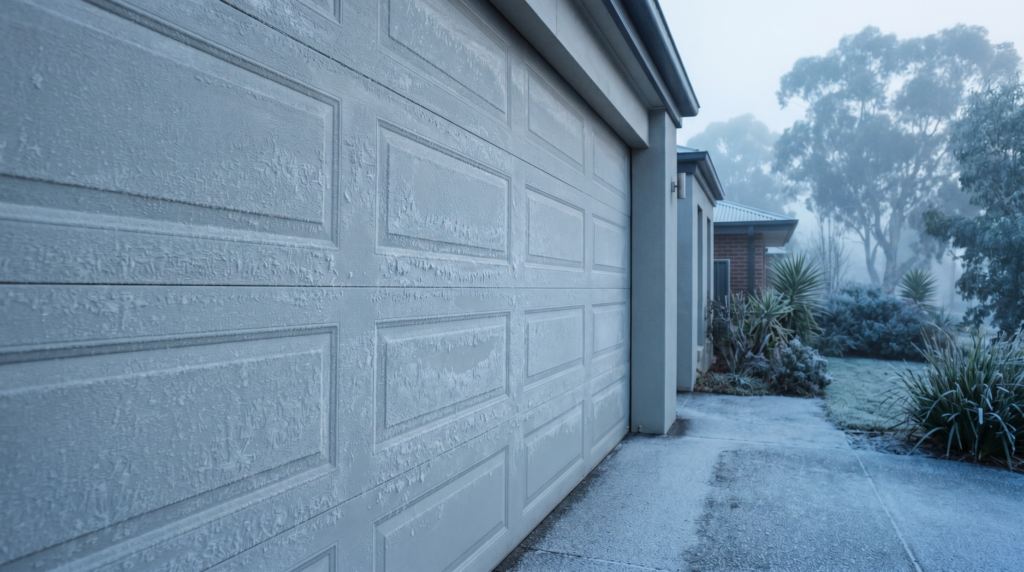
Your garage door is the largest moving panel in your home. On a standard double garage, it covers roughly 14 to 16 square metres of wall space. In summer, that panel absorbs radiant heat and pushes it into your garage. In winter, it does the opposite — it radiates cold air inward, acting as a giant cold surface pressed against your living space.
 
If your garage is attached to your home — and most Australian garages are — that cold transfer does not stay in the garage. It bleeds through the shared wall into your laundry, hallway, or bedroom. Your heating system works harder to compensate. Your energy bills go up. And the garage itself becomes unusable for months at a time.
 
An uninsulated steel garage door in winter is essentially a hole in your home’s thermal envelope. It is one of the last things most homeowners think about, and one of the most cost-effective things they can fix.

What Winter Actually Looks Like in These Climates

It is worth being specific, because “cold” means different things in different parts of Australia.
 
Toowoomba sits at approximately 700 metres elevation on the Great Dividing Range, which makes it genuinely unusual for Queensland. While the rest of the state enjoys mild winters, Toowoomba regularly records overnight temperatures below 5°C from June through August, with frosts common across the Darling Downs from April through September. Winter day averages range from just 5.3°C to 16.3°C. For Queensland, that is cold. For a steel garage door with no insulation, that is a significant heat loss problem.
 
Melbourne averages overnight minimums of around 6 to 8°C in July — and that is the city average. Outer suburbs and elevated areas regularly see temperatures closer to 2 to 4°C. Melbourne’s weather is also famously variable, meaning a 14°C afternoon can be followed by a 4°C morning with no warning.
 
Canberra is the coldest capital city in Australia by a significant margin. July overnight minimums average 0°C, and sub-zero temperatures are a regular occurrence from June through August. The ACT averages around 57 frost days per year. An uninsulated garage in Canberra in July is not just uncomfortable — it is genuinely cold enough to affect stored items, vehicles, and any living space it adjoins.
 
Tasmania presents the most sustained cold of any Australian state. Hobart winter maximums sit between 12°C on the coast and 3°C inland, with the Central Plateau averaging 0°C in winter. Cold fronts from the Southern Ocean push through regularly, and overnight temperatures below freezing are common across much of the state from May through September.

The Garage Door as a Thermal Weak Point

Steel conducts heat — and cold — extremely efficiently. A standard uninsulated sectional garage door performs at approximately R0.0, meaning it provides virtually no thermal resistance. Every degree of cold outside transfers almost directly to the inside surface of the door.
 
This matters more than most people realise for two reasons.
 
First, radiant cold is real. Standing near a large cold surface — even without a draught — makes a space feel colder than the air temperature suggests. An uninsulated steel door radiates cold into the garage the same way a hot door radiates heat in summer. The effect is measurable and uncomfortable.
Second, thermal bridging compounds the problem. The steel hinges, panel joins, and frame of a sectional garage door conduct cold even faster than the panel surface. Even if you add insulation to the panels, a product that only quotes material R-values — not assembly R-values — may be leaving the majority of the cold transfer path unaddressed.
 
This is why ThermaDoor’s R-values are calculated on the complete installed door assembly — steel, hinges, and all — under AS/NZS 4859.2:2018. The independently verified R1.43 winter assembly R-value accounts for the entire door, not just the foam panel sitting in front of it.

What Changes When You Insulate

The benefits in winter are direct and practical.
 
The garage temperature stabilises. Customers report that an insulated garage maintains a noticeably higher temperature overnight compared to an uninsulated one — not warm, but significantly less cold. The difference between 4°C and 10°C in a garage is the difference between a space you avoid and a space you can use.
Adjoining rooms stay warmer. With the cold transfer through the door reduced, the shared wall between your garage and your home stops acting as a cold sink. Rooms that previously felt draughty or hard to heat become noticeably more comfortable.
 
Heating costs come down. If your heating system is working to compensate for cold air bleeding in from an attached garage, insulating the door removes one of the largest uncontrolled heat loss paths in the house. The impact varies by home layout and heating system, but the principle is straightforward — less cold in means less heat required.
 
Condensation reduces. Cold steel surfaces attract condensation, which can damage stored items, affect vehicles, and over time cause corrosion. ThermaDoor’s sisalation foil backing acts as a Class 2 vapour barrier, reducing moisture transfer through the door and helping to manage condensation in cold conditions.
 
The garage becomes usable again. In Toowoomba, Melbourne, Canberra, and Tasmania, winter effectively locks many homeowners out of their garages for months. A home gym, workshop, or storage space that is too cold to use is wasted space. Insulation does not turn a garage into a heated room, but it makes the temperature difference between inside and outside significantly smaller — enough to make the space functional again.

Purpose-Built Matters in Winter Too

Most garage door insulation products on the Australian market are not purpose-made for garage doors. They are wall insulation, pipe insulation, or general construction products adapted for a different application. In winter conditions, this matters for a specific reason: moisture.
 
Products that use open-cell foam, polyester batts, or fibreglass insulation absorb moisture. In cold, damp conditions — which describe winter in Melbourne, Canberra, and Tasmania with precision — moisture absorption leads to reduced insulation performance, mould risk, and eventual product failure.
 
ThermaDoor uses high-density EPS (expanded polystyrene) with a laminated vinyl face and sisalation foil backing. EPS does not absorb moisture. The vinyl face is water resistant. The foil backing acts as a vapour barrier. The product is designed to perform in Australian conditions year-round — not just in summer.

Where to Start

If you are in one of Australia’s colder climates and your garage is attached to your home, garage door insulation is one of the most cost-effective thermal upgrades you can make this winter.
 
ThermaDoor is available as a DIY kit delivered to your door or through professional installation via authorised distributors across Australia.
 
Not sure what your door needs? Use our DIY price calculator to get an indicative price for your door in under two minutes — no account required
 
ThermaDoor is Australia’s original purpose-built garage door insulation. Independently verified dual-season R-values of R1.43 (winter ) and R1.39 (summer) under AS/NZS 4859.1/.2:2018. Australian made since 2012.
 

Ready to Insulate Before Winter Hits?

ThermaDoor DIY kits deliver to your door anywhere in Australia. Get an indicative price for your door in under two minutes — no account required.

Frequently Asked Questions

Does garage door insulation help in winter?

Yes. An uninsulated steel garage door performs at approximately R0.0 — virtually no thermal resistance. In winter it acts as a large cold surface, radiating cold into your garage and through the shared wall into adjoining rooms. ThermaDoor’s independently verified R1.43 winter assembly R-value significantly reduces that cold transfer, stabilising temperatures and reducing heating costs.

Yes — and Toowoomba’s climate is one of the strongest arguments for it. Toowoomba regularly drops below 5°C overnight from June through August, with frosts across the Darling Downs from April through September. An uninsulated steel door pushes cold directly into adjoining rooms and drives up heating bills. ThermaDoor’s R1.43 winter assembly R-value addresses that heat loss at the source.

Toowoomba, Melbourne, Canberra, and Tasmania experience the most significant winter cold. Canberra averages 0°C overnight in July with around 57 frost days per year. Toowoomba regularly drops below 5°C with frosts from April through September. Melbourne’s outer suburbs regularly see 2 to 4°C overnight. Tasmania experiences sustained cold from May through September with overnight temperatures below freezing common across much of the state.

It can. Insulating the garage door removes one of the largest uncontrolled heat loss paths in an attached garage. Less cold transfer through the door means your heating works less hard to maintain comfortable temperatures in adjoining rooms. The impact varies by home layout and heating system.

It depends on the product. Insulation glued directly to the back of a steel garage door — particularly peel-and-stick rubber or foam products — can actually make condensation worse, not better. Sealing a cold steel surface with an impermeable material traps moisture between the insulation and the door, accelerating corrosion and causing damage over time. ThermaDoor addresses this differently. The mechanical fixing system creates an air gap between the panel and the door surface, and the sisalation foil backing acts as a Class 2 vapour barrier. That combination manages moisture transfer rather than trapping it — which is why ThermaDoor is designed specifically for garage doors, not adapted from another application.

Yes. ThermaDoor DIY kits are designed to be installed without trades in a few hours. Panels are cut to your door’s measurements and mechanically fixed — no glue required. Kits deliver to any address in Australia. Professional installation is also available through authorised distributors in Toowoomba, Melbourne, Canberra, and Tasmania.

Picture of Peter Hinton
Peter Hinton

Peter is a licensed builder with over 45 years of experience in the construction industry. In 2012, his expertise in energy efficient construction inspired the invention of ThermaDoor Premium garage door insulation - the original purpose made garage door insulation in Australia.

ThermaDoor is the manufacturer of the products discussed in this article and has a commercial interest in their sale. While every effort has been made to ensure the accuracy of the information presented, readers are encouraged to conduct their own research and consult qualified professionals before making purchasing decisions. All R-values cited are independently verified assembly R-values under AS/NZS 4859.1/.2:2018.
ThermaDoor Installation

Let our experts handle installation for you
Or Ask Us A Question

Call, text, or send an enquiry below to see if we have an installer in your area.

Make an Enquiry