
Peter is a licensed builder with over 45 years of experience in the construction industry. In 2012, his expertise in energy efficient construction inspired the invention of ThermaDoor Premium garage door insulation - the original purpose made garage door insulation in Australia.
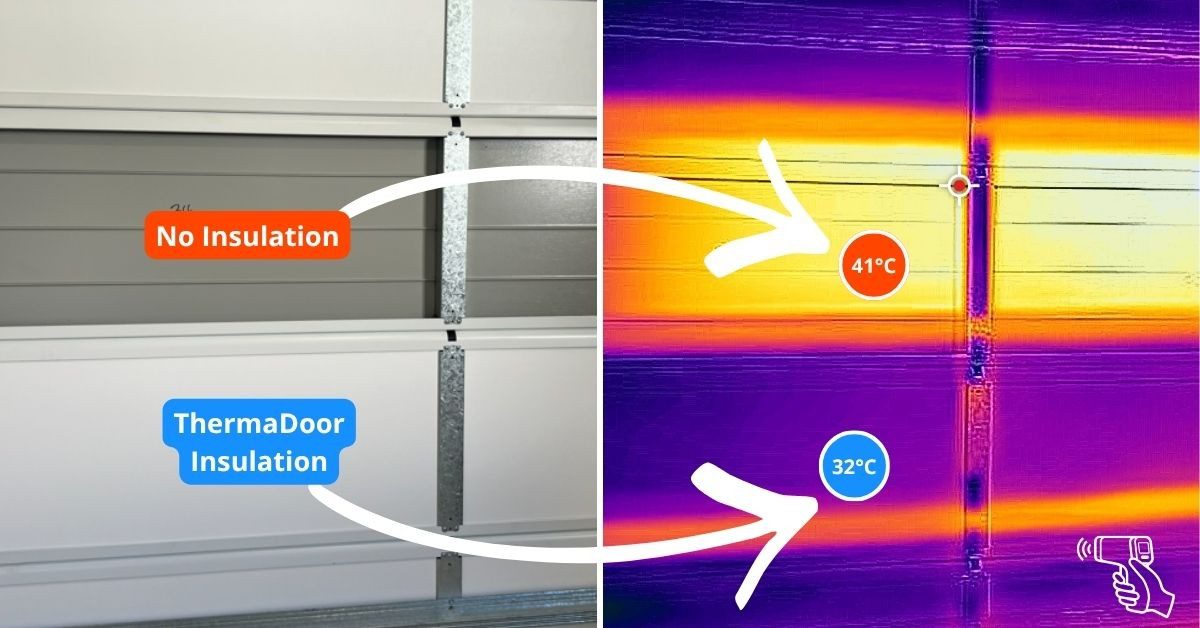
We’ve all seen the social posts – someone grabs a cheap thermal gun, zaps the front of a garage door, and proudly announces:
“Our insulation dropped the temperature by 30 degrees!”
It sounds impressive, but that so-called garage door insulation temperature difference doesn’t actually show how well the insulation performs. It only reveals how hot (or cool) the surface of one particular door was at that moment – under those exact conditions.
Let’s unpack why that’s misleading, and why ThermaDoor Premium takes a tested, standards-based approach instead.
A surface temperature reading measures the skin of the door – literally how hot or cold the outer metal is. It’s like checking your car bonnet after it’s been sitting in the sun. It might fry an egg, but that doesn’t mean the cabin inside is 70°C.
An ambient temperature, on the other hand, measures the surrounding air – inside the garage or outdoors. Air temperature changes more slowly, is affected by air movement and shading, and doesn’t reflect short-term surface spikes caused by sunlight or colour.
So, when someone says the “garage dropped 30 degrees,” ask:
Was that air or surface temperature?
Was it measured over time?
Was the door black or white?
Was it north or west facing?
What was the garage built from – brick, timber, or metal?
All of these variables can swing readings dramatically, even within the same street.
Let’s say two houses are side by side:
One has a white door facing north.
The other has a black door facing west.
At 2 pm on a sunny day, the black door could be 20 °C hotter than the white one – even with identical insulation behind it. That doesn’t mean one performs better. It just means one absorbs more sunlight.
Add in concrete floors, metal frames, roof ventilation, local wind, and how long the door’s been closed – and suddenly that “temperature difference” means very little.
Most homeowners who choose garage door insulation simply want a more comfortable, efficient space without the marketing fluff.
In the construction world, though, true performance isn’t measured in ‘degrees’ – it’s measured by how well a material resists heat flow, known as its R-value.
An R-value shows how effectively insulation slows heat transfer, no matter the weather outside.
These figures are determined through scientific calculations under stringent Australian standards, which sets out exactly how insulation must be tested for real-world use.
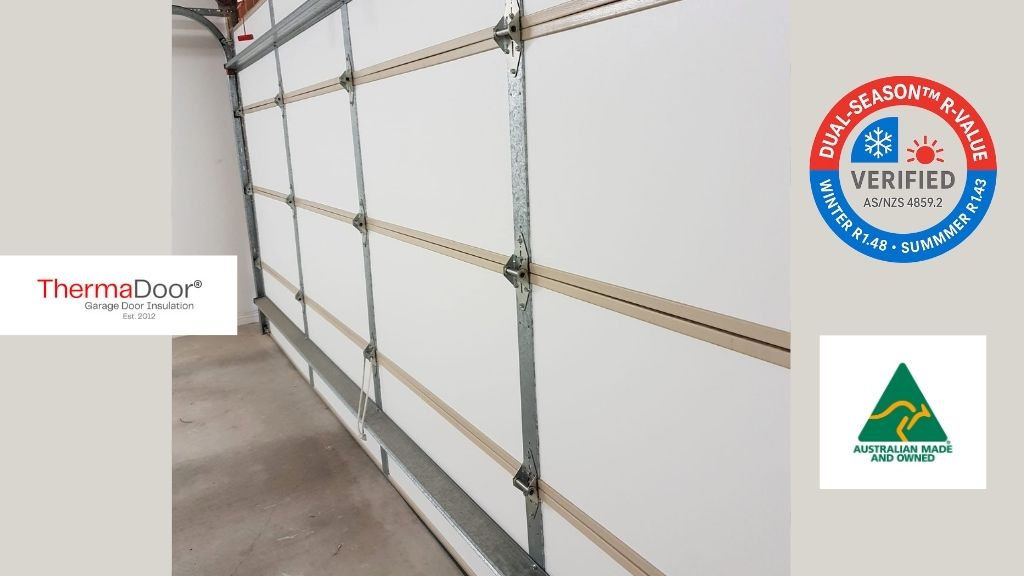
That’s why ThermaDoor Premium proudly lists verified dual-season R-values –
R1.43 (winter) / R1.39 (summer) – calculated in accordance with Australian Standards specifically for garage door assemblies, not repurposed wall or floor products.
We don’t quote ‘temperature difference’ claims alone because they’re not scientific or compliant. Only tested R-values can truly show how insulation performs across different climates, orientations, and seasons.
With Australia’s National Construction Code 2022 energy efficiency standards raising the bar for thermal performance, accurate data has never been more important. Builders, assessors, and homeowners alike need information that’s backed by science – not marketing spin.
When you insulate with ThermaDoor Premium, you’re choosing a solution that’s engineered, tested, and fully compliant and aligned with:
AS/NZS 4859.1 & 4859.2 – Thermal performance of insulation materials
AS 3999 – Installation of bulk insulation
AS/NZS 4505 – Garage door safety and spring balance
It’s genuine, proven performance – not guesswork, not surface readings.
Flashy ‘degree drop’ posts might make for good social content, but they’re not a measure of insulation performance.
At best, they show how reflective a surface is. At worst, they mislead homeowners.
So next time someone waves a cheap thermal gun and declares victory, smile and remember:
Science happens in the lab — not in the driveway.
ThermaDoor. Insulate Smart. Live Better.
Australia’s original, purpose-built garage door insulation. Tested. Proven. Compliant.
Australian Building Codes Board — National Construction Code (NCC 2022)
https://ncc.abcb.gov.au/editions/ncc-2022
→ Primary building regulation framework in Australia. Refer when discussing NCC energy efficiency requirements, NatHERS 7-Star targets, or insulation compliance obligations.
Standards Australia / Standards New Zealand — AS/NZS 4859.2:2018 Thermal insulation materials for buildings — Design
https://www.standards.govt.nz/shop/asnzs-4859-22018
→ Specifies how thermal performance of insulation (including R-values) must be measured and declared. Use when referencing verified R-values or compliance testing.
Standards Australia — AS 3999:2015 Bulk thermal insulation — Installation
https://www.intertekinform.com/en-au/standards/as-3999-2015-101372_saig_as_as_212955/
→ Covers correct installation methods for bulk insulation. Use when highlighting that insulation must be mechanically fixed, preserve air gaps, and avoid gluing to metal.
Standards Australia / Standards New Zealand — AS/NZS 4505:2012 Garage doors and other large access doors
https://www.standards.govt.nz/shop/asnzs-45052012
→ Defines safety, design, and performance standards for garage doors. Cite when discussing door weight, spring balance, and mechanical load considerations.
Australian Government — energy.gov.au — Insulation and draught proofing (households)
https://www.energy.gov.au/households/insulation-and-draught-proofing
→ Consumer guidance on insulation types, R-values, and energy savings. Supports general homeowner education and practical benefits.
Australian Government — Your Home Guide — Passive Design: Insulation
https://www.yourhome.gov.au/passive-design/insulation
→ Explains the role of insulation in passive design and energy efficiency. Great for referencing broader context (thermal mass, air gaps, condensation, etc.).
CSIRO — Thermal Insulation & Solar Performance (NATA-accredited testing including AS/NZS 4859.1)
https://research.csiro.au/infratech/thermal/
→ National scientific body responsible for testing and validating insulation materials. Reference for credibility when mentioning laboratory-tested R-values.
The term garage door insulation temperature difference refers to the change in temperature between the surface of a garage door and the surrounding air. Many people confuse this with insulation performance, but it simply reflects short-term surface heat — not true thermal resistance. The only accurate way to measure insulation performance is through tested R-values under AS/NZS 4859.2.
Surface temperature measures how hot or cold the outer metal of the door gets, while ambient temperature measures the surrounding air. Sunlight, colour, orientation, and airflow can all cause large swings in surface readings. That’s why a quick thermal-gun check can’t determine real garage door insulation performance.
Not usually. Those “15-degree drop” posts you see online are based on momentary surface readings that change with sunlight and door colour. They don’t meet Australian Standards for insulation testing. ThermaDoor Premium uses verified R-values (R1.43 winter / R1.39 summer) that show consistent, tested results — not marketing guesses.
ThermaDoor measures performance using R-values tested under AS/NZS 4859.2:2018, which defines how insulation should be evaluated for real-world use. Our results apply to complete garage door assemblies, not walls or floors, ensuring compliance with the NCC 2022 and accurate energy-efficiency outcomes for Australian homes.
Call, text, or send an enquiry below to see if we have an installer in your area.
"*" indicates required fields