
Trade & Industry Hub
Est. 2012
Australia's Original
Independently Tested
AS/NZS 4859.2:2018
Australian Made
Licence 7177
Purpose Built
For Garage Door Systems
What Makes ThermaDoor Different
Most products sold as garage door insulation are generic building materials — wall batts, PIR panels, foil wraps, or plain polystyrene sheets adapted for a use they were never designed for.
ThermaDoor is different — invented by a builder, it integrates with professional installation practices from the ground up, not as an afterthought.
Every panel is engineered specifically for the daily movement and thermal demands of a garage door system, and independently tested to Australian Standards. Here’s what’s inside every kit.
Three Layers. Engineered as One
High-Density EPS Core
Flame retardant, construction-grade expanded polystyrene foam is the primary insulator in every ThermaDoor panel. It slows conducted heat transfer through the door — keeping your garage significantly cooler in summer and warmer in winter, year after year.
UV-Stable Vinyl Facing
Durable, flame retardant, UV-resistant vinyl facing protects the panel from Australia's harsh climate. It resists fading, cracking, and weathering — delivering a clean, professional finish that holds its appearance and structural integrity for the life of the door.
Sisalation Foil Backing
Bonded to the back of every panel, this construction-grade foil reflects radiant heat, acts as a Class 2 vapour barrier, and achieves Group 1 fire performance classification. It's the same foil used to wrap Australian homes — completing the three-layer system.
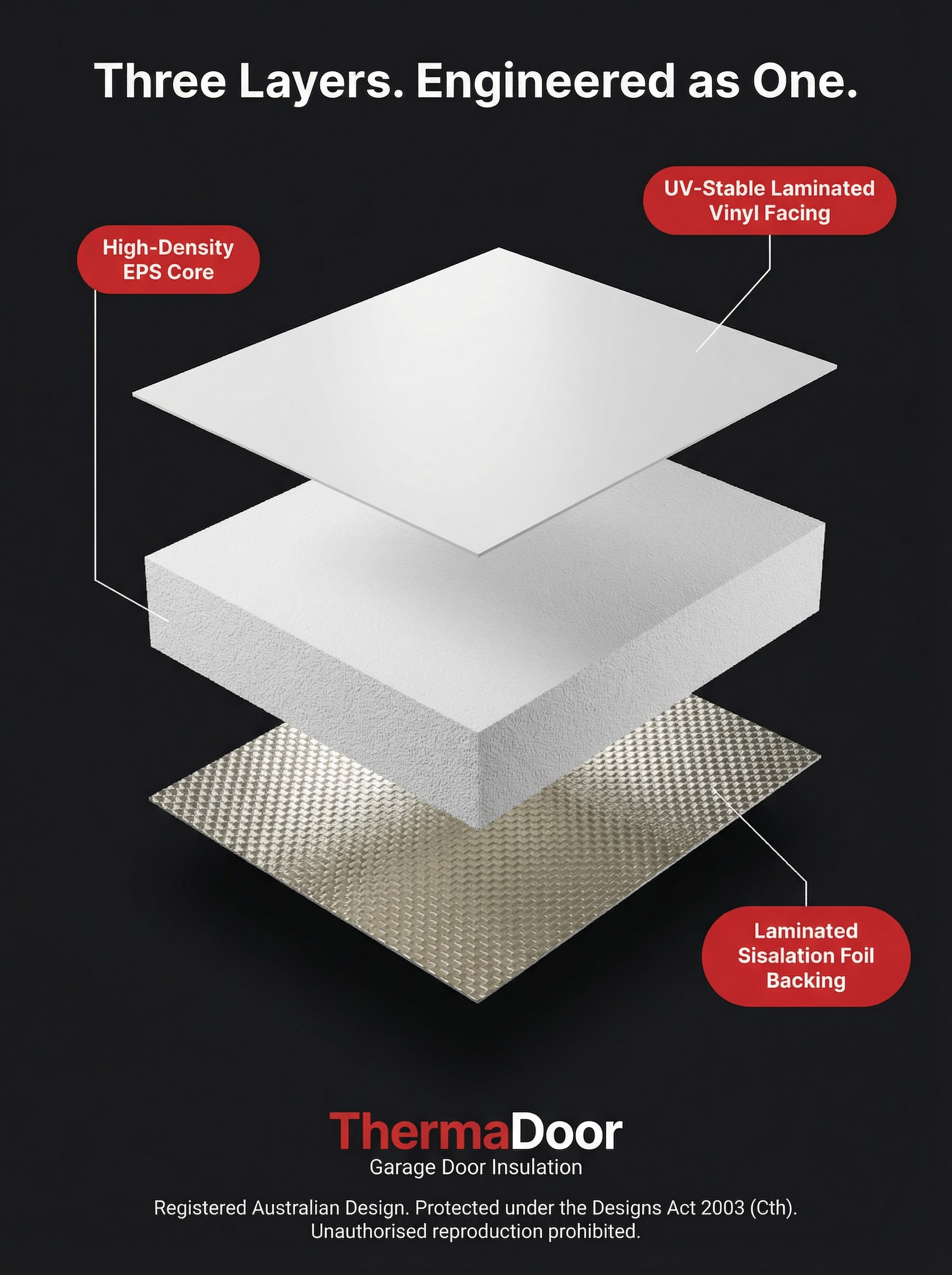
Registered Australian Design. Protected under the Designs Act 2003 (Cth). Unauthorised reproduction prohibited.
Garage Door Technicians & Businesses: Partner with Australia's Leading Garage Door Insulation.
Interested in Becoming a ThermaDoor Distributor?
We work with garage door businesses across Australia who want to offer their customers a premium, independently tested solution — one that delivers results, generates referrals, and does not come back as a callback. Whether you are quoting a new build requiring NCC 2022 compliance, or upgrading an existing door for a homeowner who has asked for ThermaDoor by name, our panels integrate seamlessly with standard sectional and tilt door installations. Mechanical fixing only — no adhesives, no special tools, no waiting. Because our panels are factory-laminated, they are exceptionally tough. No delamination, no sagging, no callbacks.
DESIGNING FOR 7 STARS
Garage Door Insulation Energy Compliance for
NCC 2022 & NatHERS 7-Star Designs
If you’re a builder, designer, architect, or homeowner working on a new home, don’t overlook the garage door in your NCC & NatHERS 7-star energy rating strategy. Since 1 October 2023, most states have begun enforcing the uplift to NCC 2022 minimum 7-star ratings for new homes, with NatHERS as the main compliance pathway. Factoring in compliant, tested garage door insulation early helps de-risk certification and avoid costly redesigns.
R1.43
Winter R-Value
R1.39
Summer R-Value
Why the Garage Door R-Value Matters in NatHERS &
NCC 2022
Under Australia’s National Construction Code (NCC 2022):
- All building fabric insulation must meet AS/NZS 4859.1:2018 and
- Use total/system R-values must be determined in accordance with AS/NZS 4859.2:2018
This is the same framework your energy assessor applies in performance modelling. This means including a tested garage door R-value can make the difference between reaching and not reaching 7-star targets – especially when margins are tight.
That’s where ThermaDoor garage door insulation stands out.
ThermaDoor is the only Australian garage door insulation brand that publishes dual-season, door assembly R-values -R1.43 (winter) / R1.39 (summer) – now a requirement under AS/NZS 4859.2:2018.
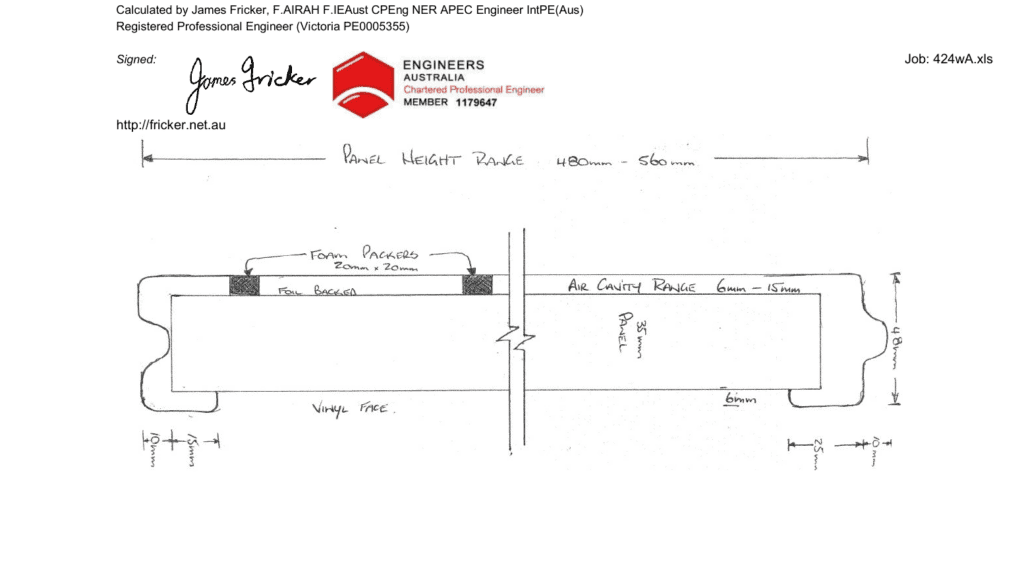
ThermaDoor Garage Door Insulation Panels: Tested, Compliant and Purpose Built for Garage Doors
Australia’s original, and still the only purpose-built garage door insulation, designed for sectional and tilt doors and tested specifically for garage door conditions provides the best R-value for garage door insulation in Australia.
Declared R-values for NatHERs Inputs
- R1.43 (winter)
- R1.39 (summer)
Australian Standards Led Methodology
- R-values determined in line with AS/NZS 2859.1:2018 (materials, test methods) and AS/NZS 4859.2:2018 (design and total/system R-value determination).
- Flammability Index Test AS 1530.2 means ThermaDoor Premium is proven to meet Australian Standards requirements for flammability.
Read more about fire ratings and garage door insulation.
Installation and Durability Benefits
- Due to our extensive construction experience, designed to integrate with professional installation practices consistent with AS 3999 for bulk insulation (installation standard).
- Purpose built panels that fit garage door geometries, support an air cavity and are moisture resistant for Australian conditions.
Key Specs (At A Glance)
| Specification | Detail |
|---|---|
| Application | Sectional and tilt garage doors — new builds and major renovations |
| Panel Thickness | 35mm |
| Declared R-Value (Winter) | R1.43 |
| Declared R-Value (Summer) | R1.39 |
| R-Value Type | Dual-season door assembly (system) values — not material or wall values |
| Standards Framework | AS/NZS 4859.1:2018 (materials and test methods) and AS/NZS 4859.2:2018 (total/system R-value determination) |
| Fixing Method | Mechanical fixing — no adhesive or glue |
| Flammability | Flame-retardant EPS core — tested to AS 1530.2 |
| NCC Compliance | Aligned with NCC 2022 building fabric provisions |
| NatHERS Support | Declared values suitable for NatHERS 7-Star design inputs |
Thermal bridging makes garage doors a special case – see our detailed blog on Why Your Garage Door Has An R-Value of Zero – And How to Fix it
ThermaDoor Warranty
ThermaDoor panels are backed by a manufacturer’s warranty covering defects in materials and workmanship. Our warranty reflects our confidence in the quality of Australian-made construction — because a product built to last should be guaranteed to last.
Frequently Asked Questions
Can I use wall or ceiling R‑values for a garage door in NatHERS?
No. NCC 2022 and NatHERS require standard‑aligned inputs. Use garage‑door specific, tested values determined under AS/NZS 4859.1 & 4859.2 to avoid rating errors.
Where do the ThermaDoor R‑values come from?
ThermaDoor’s dual-season R-values were calculated by James M Fricker Pty Ltd, a Registered Professional Engineer (Victoria, PE0005355), in accordance with AS/NZS 4859.1:2018 (materials and test methods) and AS/NZS 4859.2:2018 (total/system R-value determination), expressly for garage door assembly conditions. (Reports available on request).
Does garage‑door insulation help achieve 7‑Stars?
It can. The 7‑Star uplift places tighter budgets on heating/cooling loads; improving a large, conductive surface like the garage door often helps projects meet targets.
Is this recognised in the NCC?
Yes. NCC 2022 Volume Two Part 13.2 requires insulation to comply with AS/NZS 4859.1 and uses AS/NZS 4859.2 for total/system R‑value calculations in relevant building‑fabric elements.
What about a material R-value (sometimes referred to as a 'standalone' R-value?
A material R-value measures the thermal resistance of the insulation product in isolation. It does not account for the real-world assembly it is installed in. For a garage door — a metal structure subject to thermal bridging, air movement, and seasonal temperature variation — the material R-value will almost always overstate actual performance. This is why AS/NZS 4859.2:2018 requires total system R-values to be calculated for the specific assembly. ThermaDoor’s declared values are system R-values, not material values.
Got more questions? Read our Garage Door Insulation FAQ’s to learn about the original, and still the only purpose made garage door insulation in Australia