DIY Garage Door Insulation – How to Insulate Your Garage Door Yourself

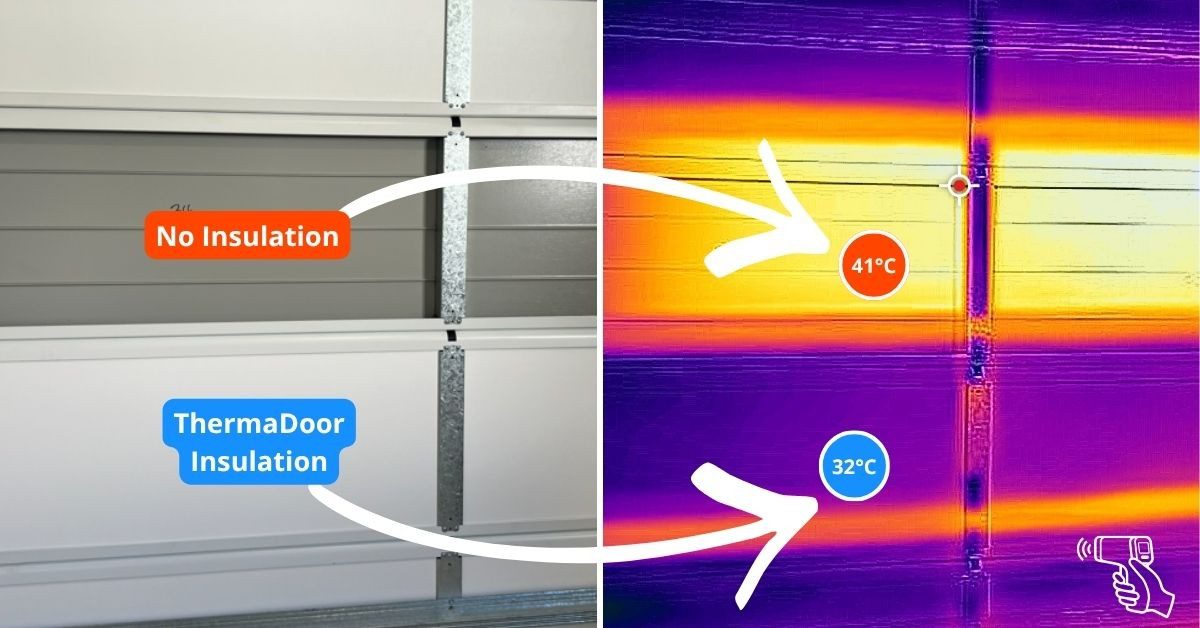
FLIR thermal image comparison showing garage door surface temperature — 41°C without insulation vs 32°C with ThermaDoor insulation
Home / Installation & Technical How-To / DIY Garage Door Insulation – How to Insulate Your Garage Door Yourself

DIY Garage Door Insulation – How to Insulate Your Garage Door Yourself

Uninsulated metal garage doors are massive thermal bridges. In summer, they radiate intense heat into your home, turning the garage into an oven. In winter, they bleed warmth out, leaving the space freezing and unusable. If you are tired of extreme temperature swings, DIY garage door insulation is one of the most cost-effective upgrades you can make to your home.
 
Yes, you can insulate your garage door yourself. But before you start gluing foam boards or taping reflective bubble wrap to your door panels, you need to understand how a garage door operates and what materials are actually safe to use.
 
Here is exactly how to insulate your garage door the right way, without damaging the door.

The 3 Rules of DIY Garage Door Insulation

Not all insulation is suitable for a moving, flexing metal door. When choosing a DIY solution, you must follow three strict rules.

1. Lightweight Materials Only — Protect Your Door Springs

A standard double garage door weighs around 150kg, and the springs are tensioned precisely to balance that weight. If you stick heavy materials like PIR, thick rubber, or dense acoustic foam to the panels, the door will become too heavy for the motor to lift. This will burn out the opener and stretch or snap the springs. A purpose-made system like ThermaDoor adds very little weight, meaning your door will continue to operate smoothly without requiring expensive spring adjustments.

2. Mechanically Fixed, Not Glued — Let the Door Flex

Garage doors are not rigid walls. They bend, flex, and vibrate every time they open and close. Gluing foam directly to metal skins is one of the most common DIY mistakes. Rigid boards glued to a flexing door will eventually pop off, and the glue itself can degrade in extreme heat. Australian Standards (AS/NZS 4505) dictate how a garage door must operate — modifications that impede natural movement do not meet the intent of the standard. Insulation must be mechanically fixed so it can move with the door.

3. Always Maintain an Air Gap — Prevent Rust and Condensation

If you push insulation flat against the metal skin of the door, you trap moisture. When cold metal meets warm internal air, condensation forms. Over time, this trapped moisture causes the door to rust from the inside out. A proper insulation system maintains an air gap between the metal and the foam, allowing the door to breathe while drastically improving thermal performance.

How the ThermaDoor DIY System Works

ThermaDoor is Australia’s original, purpose-made garage door insulation. It is not repurposed wall insulation — it is an engineered system designed specifically for sectional and tilt doors.
 
The system features three components working together:
 
  • high-density EPS core that provides the thermal mass
  • laminated white vinyl face that is easy to wipe clean, provides protection to the core and brightens the space
  • sisalation foil backing — the same type of foil material used to wrap houses for thermal protection, and also acts as a Class 2 vapour barrier
Because the panels are mechanically fixed — no glue, no mess — the installation process is straightforward and requires no special skills or tools.

The 4-Step DIY Installation Process

Step 1: Measure the panels both height and width
 
Step 2: Cut to size Using a straight edge and a sharp utility knife.
 
Step 3: Place foam packers Install the foam packers on the back of each metal door section to hold the panel firmly in place.
 
Step 4: Insert ThermaDoor panels Slide the top of the individually cut panel up into the top of the door section, gently push the bottom of the panel past the top edge of the bottom lip.
 
Visit our DIY garage door insulation instructions page for written instructions and further videos.


Independently Tested Performance for Australian Conditions

When evaluating any insulation product, always ask for independent evidence. ThermaDoor’s dual-season thermal performance has been independently tested to AS/NZS 4859.1 and 4859.2:2018, delivering a verified assembly R-value of R1.43 in winter and R1.39 in summer.
 
Do not be misled by products quoting high material R-values. A garage door is a moving metal structure, and the only number that matters is the verified assembly R-value — the performance of the insulation after it is installed in the door, accounting for the metal frame and all thermal bridging. Material R-values alone are misleading and do not reflect real-world performance.

How ThermaDoor Compares to Other DIY Garage Door Insulation Methods

Method R-Value Weight Moisture Risk Glue Required Purpose-Made
ThermaDoor R1.43 independently tested assembly Light No — Class 2 vapour barrier built in No — mechanically fixed Yes
Foam board (EPS/XPS glued on) Material only — no assembly test Medium–Heavy Yes — traps condensation Yes No
Reflective bubble wrap / foil only Negligible without air gap Light Low Yes No
PIR rigid boards Material only — no assembly test Heavy Yes — no vapour barrier Yes No
Rockwool / fibreglass batts Not suitable for moving doors Heavy High — absorbs moisture No No

Foam Board Glued Directly to the Door

This is the most common DIY approach and the most problematic. Foam board (EPS or XPS) is cheap and widely available, but it is designed for walls and ceilings — not moving metal doors. Gluing rigid boards across door panels impedes the natural flex of the door, which can cause the boards to crack and detach over time. There is no vapour barrier, so condensation builds up behind the foam. And because the foam sits flush against the metal skin with no air gap, the thermal performance is significantly lower than the material R-value suggests.

Reflective Foil and Bubble Wrap

Reflective foil products are heavily marketed as insulation, but foil alone does not insulate — it reflects radiant heat only when there is an air gap on both sides. Sticking foil directly to a metal door is the equivalent of putting aluminium foil against a hot pan. Without the air gap, there is no meaningful thermal benefit. These products are not purpose-made for garage doors and provide negligible R-value in real-world conditions.

PIR Rigid Boards

PIR (polyisocyanurate) boards have a high material R-value, which makes them appear attractive on paper. However, a garage door is a moving metal structure, and material R-values do not account for thermal bridging. PIR boards are stiff and brittle — they are not designed to flex with a door that opens and closes multiple times a day. There is no independent assembly R-value data available for PIR applied to garage doors, and no purpose-made fixing system exists for them. They also add significant weight, which places additional load on door springs and motors.
 

ThermaDoor — Purpose-Made for the Application

ThermaDoor is the only system in Australia independently tested as a complete installed assembly on a garage door. The R1.43 winter / R1.39 summer assembly R-values are verified under AS/NZS 4859.1 and 4859.2:2018 — not estimated, not calculated from material data sheets. The system is mechanically fixed (no glue), lightweight (no spring adjustment required), and includes a built-in Class 2 vapour barrier that prevents condensation from forming behind the insulation. It is the only product designed from the ground up for the specific demands of a moving, flexing, Australian garage door.

Get Started with Your DIY Project

Insulating your garage door transforms the space from a structural weak point into a comfortable, usable extension of your home — whether that is a home gym, a workshop, a hobby room, or simply a cooler, drier place to park.
 
Ready to tackle the project yourself? Browse our DIY Kits and get everything you need delivered Australia-wide.
 
Prefer to have it done for you? Our nationwide network of approved distributors offers professional supply and install across Australia.
 
Looking for local DIY kits or professional installation in the Darling Downs? Visit our dedicated Garage Door Insulation Toowoomba page.

DIY Garage Door Insulation — Frequently Asked Questions

Is DIY garage door insulation worth it?

Absolutely. It is one of the most cost-effective ways to reduce heat transfer into your home. A properly insulated door can drop the internal temperature by up to 20°C on a hot day, making the garage usable for gyms, workshops, or storage while lowering your overall energy bills.

A premium, purpose-made DIY kit for a standard double garage door typically costs around $640. This is significantly cheaper than hiring a professional installer or replacing the entire door with a pre-insulated model.

The best insulation is a system purpose-made for garage doors. It must be lightweight to protect the springs, mechanically fixed to allow the door to flex, and designed with an air gap to prevent rust and condensation. High-density EPS with a radiant foil backing — like ThermaDoor — is the proven standard for Australian conditions.

No. If you are comfortable using a tape measure and a utility knife, you can install a purpose-made kit yourself in a couple of hours. However, if you prefer not to do it yourself, ThermaDoor has a nationwide network of approved distributors who offer professional supply and install services.
Picture of Peter Hinton
Peter Hinton

Peter is a licensed builder with over 45 years of experience in the construction industry. In 2012, his expertise in energy efficient construction inspired the invention of ThermaDoor Premium garage door insulation - the original purpose made garage door insulation in Australia.

ThermaDoor is the manufacturer of the products discussed in this article and has a commercial interest in their sale. While every effort has been made to ensure the accuracy of the information presented, readers are encouraged to conduct their own research and consult qualified professionals before making purchasing decisions. All R-values cited are independently verified assembly R-values under AS/NZS 4859.1/.2:2018.

ThermaDoor Installation

Let our experts handle installation for you
Or Ask Us A Question

Call, text, or send an enquiry below to see if we have an installer in your area.

Make an Enquiry