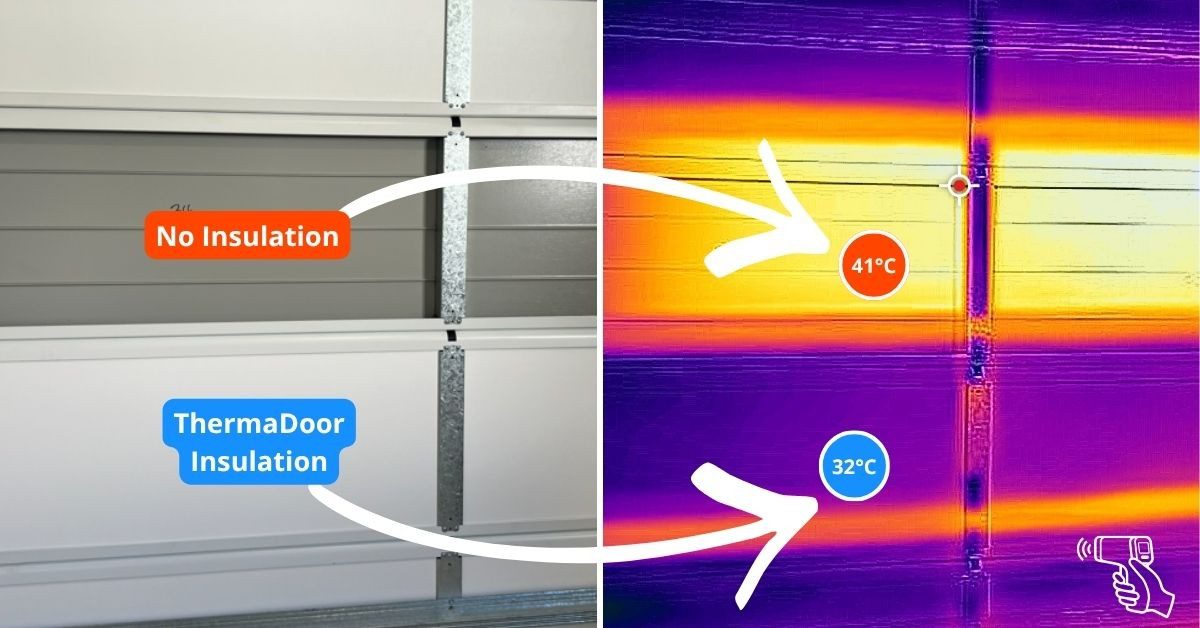
Understanding the difference between material R-values and assembly R-values is essential for NCC 2025 compliance and achieving genuine thermal performance.
NCC 2025 Principle | How ThermaDoor Delivers |
System-Based Performance | ThermaDoor is the only Australian brand publishing independently verified assembly R-values (R1.43 Winter / R1.39 Summer) calculated for a complete garage door system, not just the insulation material. |
Accounting for Thermal Bridging | Our R-value calculations account for the thermal bridging effect of the metal door frame and skin, providing realistic performance data. |
Correct Use of Air Gaps | Our purpose-built mechanical fixing system preserves the essential air cavity between the insulation panel and door skin, which is factored into our assembly R-value and critical for thermal performance. |
Purpose-Built Design | ThermaDoor is not repurposed wall insulation. It uses a lightweight, rigid, moisture-resistant Expanded Polystyrene (EPS) core with a durable vinyl face and reflective foil back, specifically engineered for garage door conditions. |
Compliance with Australian Standards | Our product and testing methodology comply with AS/NZS 4859.1 and 4859.2:2018, the standards directly referenced by the NCC for thermal insulation. |
Dual-Season R-Values | We provide separate winter and summer R-values because heat flow behaves differently in different seasons, giving a more complete picture of year-round performance. |
Understanding these changes and choosing the right garage door insulation is vital for compliance, performance, and long-term value.
Choosing garage door insulation with a verified assembly R-value gives you confidence that your investment will deliver genuine comfort and energy savings. It ensures your home meets the latest NCC 2025 energy efficiency standards, future-proofing your property and potentially increasing its value. When a product only quotes a material R-value, you are taking a risk that the real-world performance will fall short.
Specifying a garage door insulation product with a documented, compliant assembly R-value provides a clear and straightforward pathway to meeting the thermal performance requirements for 7-star NatHERS designs under NCC 2025. It removes guesswork and reduces the risk of compliance issues during certification. Using products with only material R-values can lead to inaccurate energy modelling and potential non-compliance.
Using a product with a verified assembly R-value allows for more accurate and reliable modeling in NatHERS software. It ensures that the thermal performance you model is the performance that will be delivered in the completed building, leading to more dependable 7-star ratings and reducing the risk of rating disputes or failures.
To ensure your garage door insulation meets NCC 2025 requirements and delivers genuine performance, ask these critical questions:
Achieving a 7-star NatHERS rating under NCC 2025 requires optimizing the thermal performance of the entire building envelope. The garage door is often overlooked, but it can represent a significant area of heat gain and loss, especially in homes with attached garages or rooms above the garage.
ThermaDoor provides detailed technical specifications and thermal test reports that energy assessors can use for accurate NatHERS modelling, simplifying the compliance process.
Designing a 7-star home? Read our guide to garage door insulation for NCC 2022 & NatHERS compliance.
NCC 2025 continues the energy efficiency requirements established in NCC 2022, including the 7-star NatHERS standard for new homes. The key difference is an even stronger emphasis on system-based thermal performance and compliance with Australian Standards like AS/NZS 4859.2:2018, which requires assembly R-values rather than material R-values alone.
If your home was built under previous NCC versions, you are not required to upgrade. However, if you are building a new home or undertaking renovations that require compliance with NCC 2025 (from May 1, 2026), choosing garage door insulation with verified assembly R-values will ensure compliance and optimal performance.
Look for products that explicitly state their R-values are calculated to AS/NZS 4859.2:2018 for the complete garage door assembly. The product should provide documentation from an independent thermal engineer and specify separate winter and summer R-values. Be wary of products that only quote material R-values or use vague terms like “up to” or “equivalent to.”
Wall insulation is not designed for garage doors and will not deliver the same performance. Garage doors are moving, weight-sensitive mechanical systems with significant thermal bridging through metal components. Using repurposed wall insulation may result in inaccurate R-values, potential door damage, and non-compliance with NCC 2025 requirements.
ThermaDoor provides independently verified assembly R-values (R1.43 Winter / R1.39 Summer) that energy assessors can accurately input into NatHERS software. This ensures your garage door’s thermal performance is correctly modeled, contributing to your overall 7-star rating. We also provide detailed technical specifications and thermal test reports to support the assessment process.
Want to dive deeper into garage door insulation and R-values? These articles provide additional insights:
Understanding R-value: What It Really Means for Garage Door Insulation
Best Garage Door Insulation R-Value in Australia (Explained)
How to Compare Garage Door Insulation Options in Australia

Peter is a licensed builder with over 45 years of experience in the construction industry. In 2012, his expertise in energy efficient construction inspired the invention of ThermaDoor Premium garage door insulation - the original purpose made garage door insulation in Australia.
ThermaDoor is the manufacturer of the products discussed in this article and has a commercial interest in their sale. While every effort has been made to ensure the accuracy of the information presented, readers are encouraged to conduct their own research and consult qualified professionals before making purchasing decisions. All R-values cited are independently verified assembly R-values under AS/NZS 4859.1/.2:2018.
Call, text, or send an enquiry below to see if we have an installer in your area.
"*" indicates required fields