The Complete Guide to Garage Door Insulation in Australia
Expert knowledge, Australian conditions, independent testing. Start here.
Welcome to the ThermaDoor Learning Centre. If you are researching how to make your garage more comfortable, reduce your energy bills, or create a usable space year-round, you have found the definitive resource.
This guide serves as your starting point. It covers the fundamentals of garage door insulation in Australia, answers the most common questions homeowners ask, and directs you to our detailed, expert-written resources across four key categories: Australian Standards and Compliance, Materials and Product Comparisons, Climate and Comfort Guides, and Installation and Technical How-To.
Why Garage Door Insulation Matters in Australia
The Australian climate is notoriously harsh. Whether you are dealing with blistering summer heat in Queensland or freezing winter mornings in Victoria, the garage is often the weakest link in your home’s thermal envelope. A standard, uninsulated steel garage door acts as a giant radiator in summer and a freezer in winter.
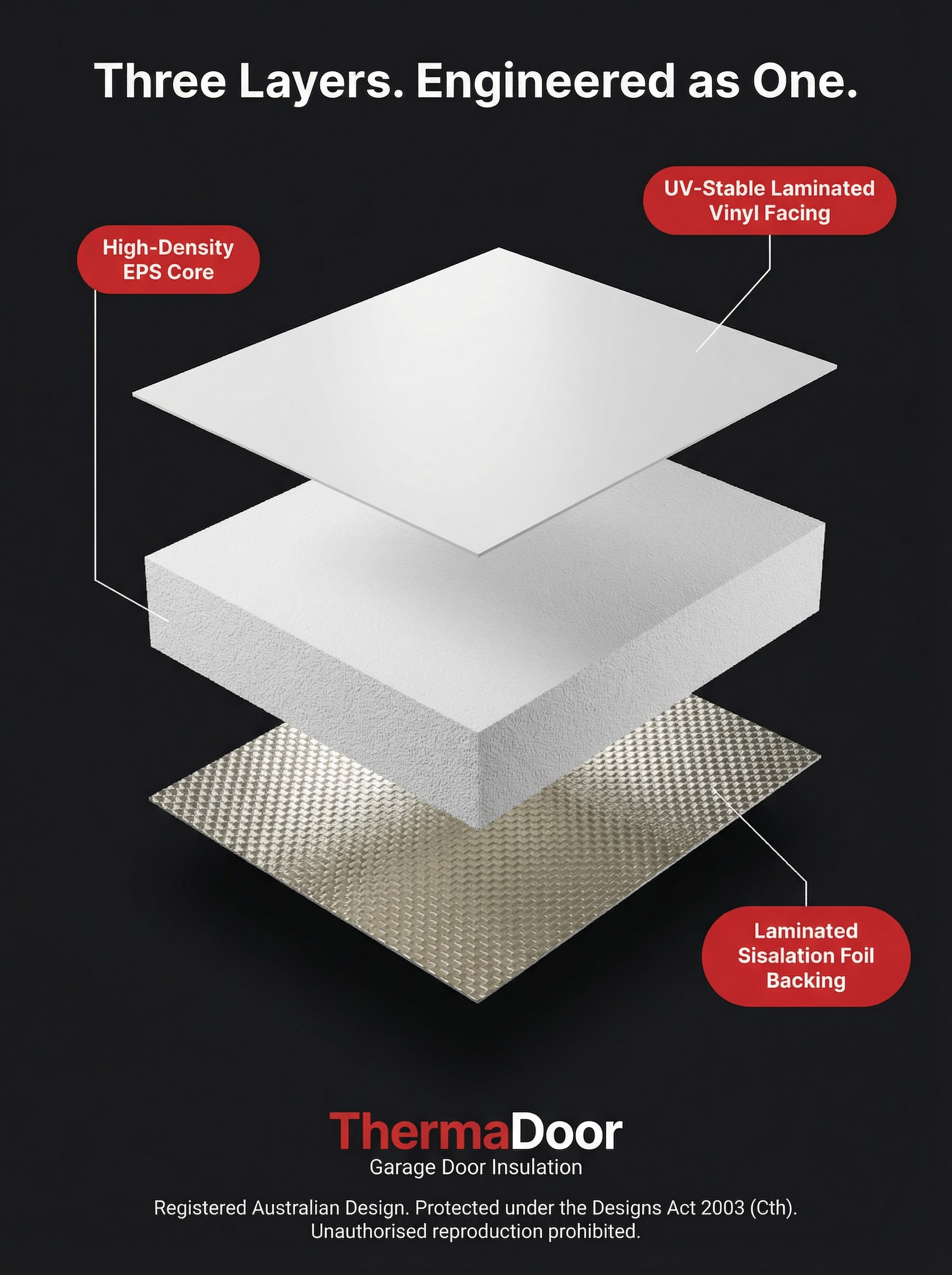
By insulating your garage door, you can regulate the temperature inside the garage, making it usable as a gym, workshop, or home office. You reduce heat transfer into adjacent living spaces, lowering your overall heating and cooling costs. ThermaDoor’s sisalation foil backing also acts as a class 2 vapour barrier, adding a layer of moisture protection that standard products do not provide. And because insulated panels add mass to the door, street noise and door operation noise are reduced significantly.
Answering the Most Common Questions
Can you insulate a garage roller door in Australia?
While it is technically possible to stick thin materials to a roller door, true high-performance insulation is designed for sectional and tilt doors. Roller doors roll up tightly into a drum, meaning thick, rigid panels cannot be used. For sectional and tilt doors, custom-cut rigid panels offer the best thermal performance without interfering with the door’s mechanics.
What type of insulation is best for garage doors?
The best insulation for a garage door is a rigid, lightweight panel that provides high thermal resistance without adding excessive weight to the door motor. Expanded Polystyrene (EPS) with a sisalation foil backing is widely considered the premium standard. It is crucial to understand that standard wall batts, polyisocyanurate IPIR foam, and other wall insulation products are designed for static walls, not moving doors. A garage door requires a product engineered specifically for movement, moisture control, and impact resistance.
Is it worth putting insulation on your garage door?
Absolutely. An uninsulated garage door has an R-value of practically zero. It offers no resistance to heat flow. Adding high-quality insulation transforms the door into a genuine thermal barrier. Homeowners consistently report significant temperature differences inside the garage after installation, making it one of the most cost-effective comfort upgrades available.
What is the best insulation for Australian homes?
For the walls and ceiling of a home, traditional bulk insulation works well. However, the garage door is a unique environment. The best insulation for this specific application must be lightweight, rigid, and feature a proper vapour barrier. Products designed for walls simply do not meet these requirements.
Understanding R-Values: The Truth About Thermal Performance
When researching insulation, you will encounter the term R-value, which measures resistance to heat flow. However, the garage door industry is filled with misleading claims about R-values, and understanding the difference could save you from a costly mistake.
There are two very different numbers you will see quoted. A material R-value measures only the insulation panel itself in a laboratory setting. An assembly R-value measures the performance of the entire door system, including the steel, the insulation, and the air gaps. Because steel is a highly conductive material, the entire garage door acts as a thermal bridge, transferring heat around the insulation panel. This means a product quoting only a material R-value is giving you an inflated number that does not reflect real-world performance.
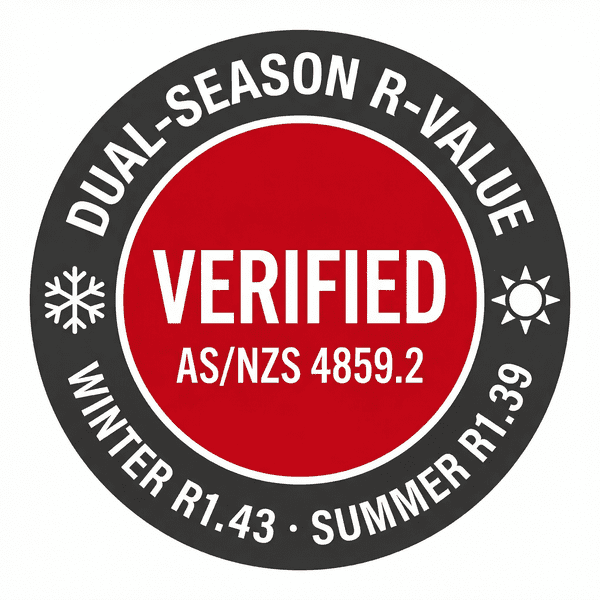
ThermaDoor provides an assembly-calculated, dual-season R-value substantiated by independent engineering reports. This means the number we quote is the number you actually get.
Explore the Learning Centre
Australian Standards & Compliance
Navigating building codes can be complex. In this section, we break down the NCC 2025 requirements, explain what Australian Standards mean for your home, and show you how to ensure your insulation is fully compliant. Explore the Articles
Materials & Product Comparisons
Not all insulation is created equal. Here, we compare different materials, explain why wall insulation is not suitable for garage doors, and look at the failures of basic reflective foil. Learn why laminated construction and mechanical fixing are non-negotiable for long-term durability. Explore the Articles
Climate & Comfort Guides
Whether you are trying to keep the garage cool in a Perth summer or warm in a Hobart winter, these guides offer practical advice. We explore temperature differences, surface readings, and how to manage the unique climate challenges across different Australian states. Explore the Articles
Installation & Technical How-To
From understanding how weight affects your door motor to the benefits of flame-retardant seals, these articles provide the technical knowledge you need for a safe, effective installation. Explore the Articles
Not Sure What to Look For When Buying?
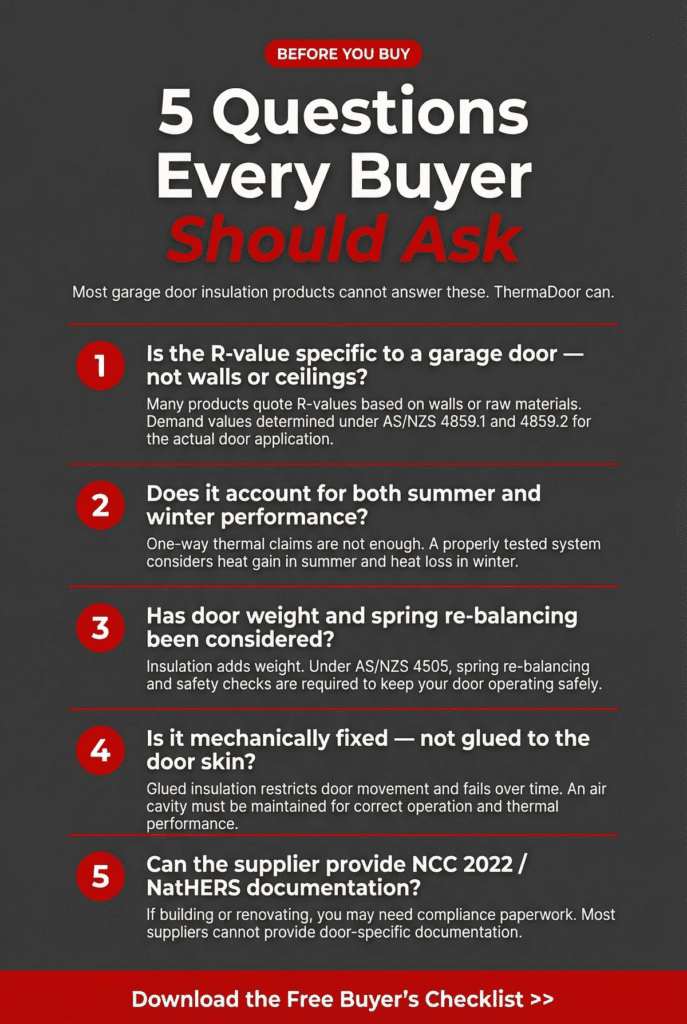
Download the ThermaDoor Buyer’s Checklist. It covers the essential questions every Australian homeowner should ask before choosing a product, from verifying engineering reports to understanding installation methods.