BEFORE YOU BUY
Most garage door insulation products are marketed using terminology borrowed from walls and ceilings. This free checklist gives you the five questions that cut through the noise — and that most suppliers cannot answer.
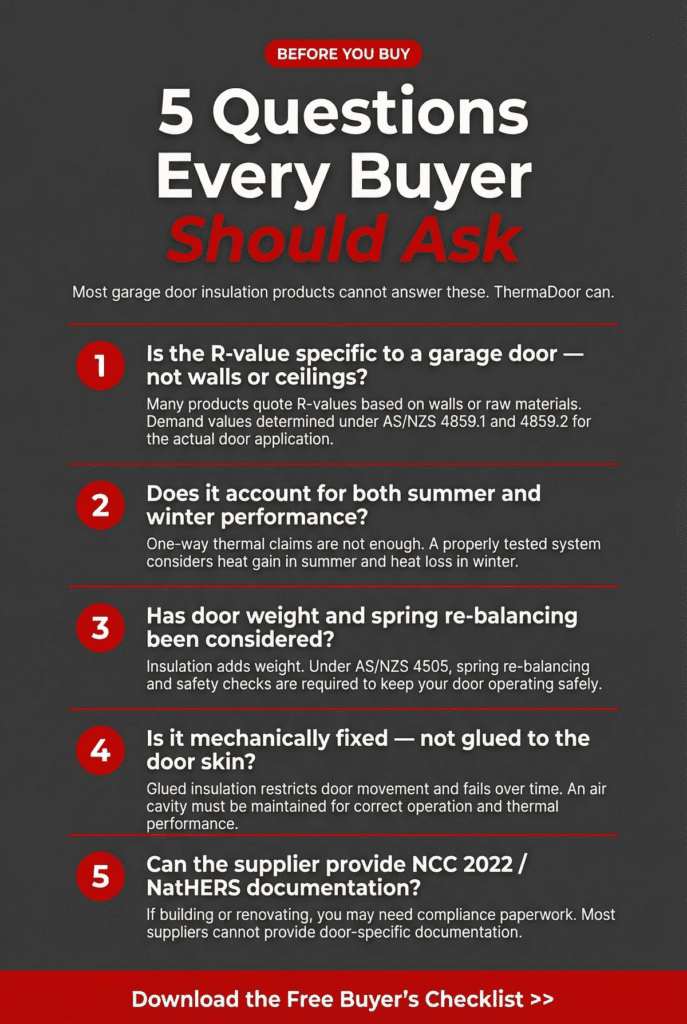
Each section helps you compare garage door insulation options on the factors that actually matter for a moving door system — not just the headline number or no number at all.
Confirms whether quoted R-values apply to a garage door application specifically, tested under AS/NZS 4859.1 and 4859.2 — not raw material values borrowed from wall insulation.
Prompts you to check how the insulation system interacts with a door that opens, closes, and flexes. Wall-style solutions do not automatically translate to a moving door.
Covers how the insulation is fixed to the door, whether added weight has been considered, and how safe operation is maintained after installation under AS/NZS 4505.
Encourages you to consider condensation, moisture exposure, and how materials are likely to perform over time in a garage environment.
Provides prompts for homeowners who may need supporting documentation for building approvals, NatHERS energy assessments, or NCC 2022 compliance.
A single headline R-value with no explanation. Insulation glued to the door skin. No mention of spring adjustment. Claims that standards are "not relevant." These are all red flags.
If a supplier or product cannot clearly answer these points, that is important information in itself.
Garage door insulation cannot be compared in the same way as wall or ceiling insulation because a garage door is a moving system. It opens, closes, flexes slightly, and relies on springs and hardware to operate safely. Insulation products designed for fixed building elements may not perform the same way when applied to a garage door. Comparing garage door insulation requires considering door movement, added weight, fixing methods, and ongoing operation — not just material thickness or advertised R-values.
Garage door insulation R-values are often quoted in different ways. Some products list material R-values, which describe the insulation material on its own rather than how it performs once installed on a garage door. Other products do not quote an R-value at all, making it difficult to understand or compare expected thermal performance. ThermaDoor’s R-values are independently tested under AS/NZS 4859.1 and 4859.2:2018 for the complete installed door assembly — not just the insulation panel on its own.
Yes, adding insulation increases the overall weight of the door, which can change door balance and spring loading. Under AS/NZS 4505, spring re-balancing and safety checks are required after any modification that changes door weight. ThermaDoor panels are designed with door weight in mind, and installation instructions include guidance on spring adjustment.
An air gap allows the garage door to continue operating as it was designed to — opening, closing, and flexing naturally with temperature changes. When insulation is glued directly to the door skin, that natural movement can be restricted, which may place unnecessary stress on the door over time. ThermaDoor panels are mechanically fixed, not glued, preserving the air cavity and door movement.
The garage door insulation buyer’s checklist is designed for homeowners who want a clearer way to compare garage door insulation options. It can be used when researching products online, comparing quotes, planning a DIY installation, or discussing options with an installer or energy assessor. The checklist helps bring clarity to an area where information and terminology are often inconsistent.
Use it to compare garage door insulation options clearly before you spend a cent. One page. Plain English. Built for Australian garage doors.
Call, text, or send an enquiry below to see if we have an installer in your area.
"*" indicates required fields