Graphite Garage Door Insulation: The Honest Facts

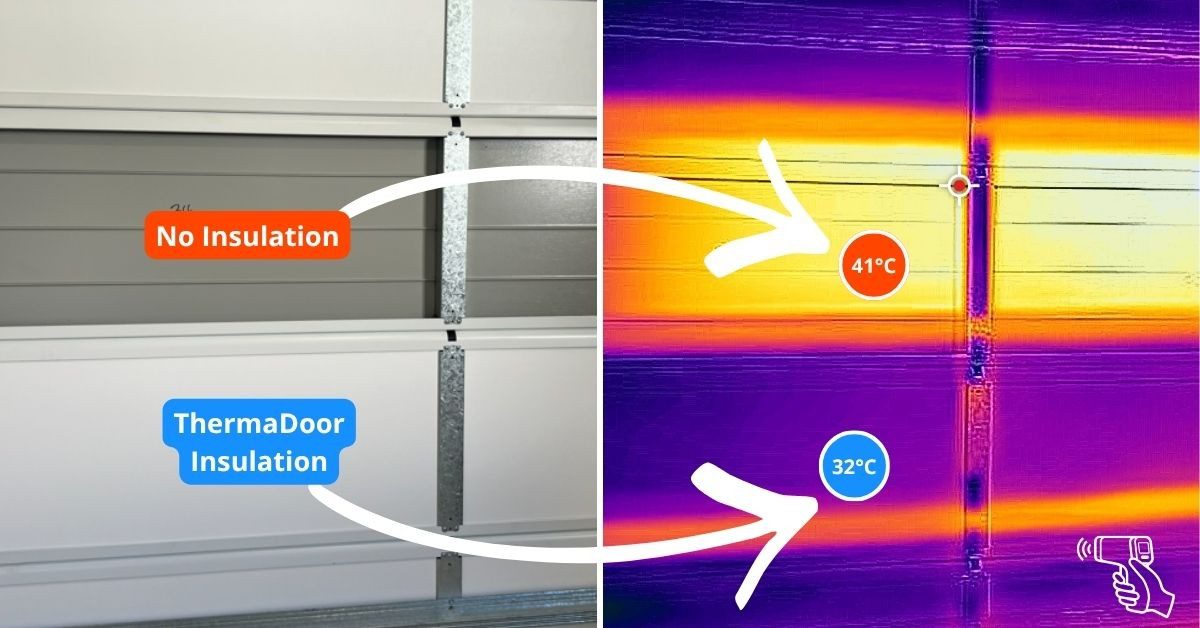
FLIR thermal image comparison showing garage door surface temperature — 41°C without insulation vs 32°C with ThermaDoor insulation
Home / Materials & Product Comparisons / Graphite Garage Door Insulation: The Honest Facts

Graphite Garage Door Insulation: The Honest Facts

More and more Aussie homeowners are looking to insulate their garage doors to reduce heat and cold, especially when using the space as a workshop, home gym, or kids play area.
 
If you have been researching options online, you have likely come across social media videos promoting black or dark grey graphite insulation panels for garage doors. The claims sound impressive. But before you spend your money, here is what the science actually says — and why the product you choose matters more than you might think.

Last updated: April 2026
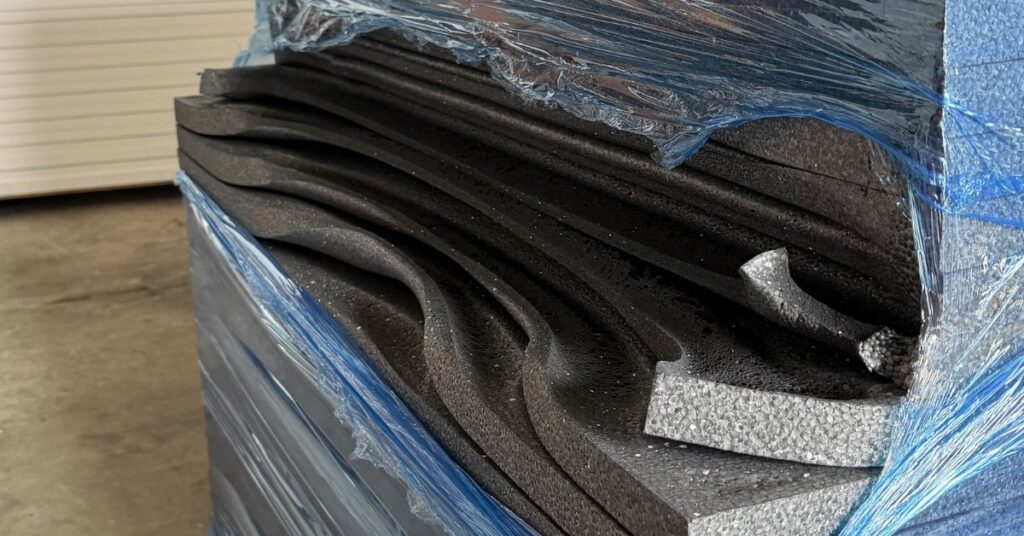
Table of Contents

What is Graphite Polystyrene (GPS) Insulation?

Graphite polystyrene (also called GPS, graphite EPS, or graphite carbon polystyrene) is standard polystyrene foam with graphite particles added during manufacturing. The graphite helps slow down heat movement through the material, giving it roughly 20% better thermal performance than plain white polystyrene of the same thickness.
 
It is not a new product. GPS has been made in Australia for over 15 years and is widely used in walls, ceilings, and floors — where it is protected behind render, cladding, or plasterboard. Several large polystyrene manufacturers supply it across the country.
 
That is the honest truth: GPS is a good building material in the right application. The problem is that a garage door is not the right application — and here is why.

The Problem Nobody Selling GPS Panels Tells You About

GPS Hits its Thermal Limit in a Steel Garage Door

The dark grey colour that makes GPS look sleek is caused by the graphite particles. Those same particles absorb heat from the sun extremely efficiently. In a wall, that is not a problem because the foam is hidden behind cladding. On a garage door, it is a serious issue.
 
According to peer-reviewed research published in Energies (Krause & Nowoświat, 2020), unprotected GPS panels exposed to solar radiation levels common in Australia reached their softening point of approximately 80°C under windless conditions. At radiation levels above 1,000 W/m², the panels physically deformed and melted.
 
Now consider this: a dark-coloured steel garage door facing the afternoon sun in an Australian summer regularly reaches 60–80°C on its surface. That heat conducts directly into any foam panel pressed against it. And unlike the outside of your house, a garage door has no wind to cool it down.
 
The result: GPS installed on an Australian steel garage door is routinely exposed to temperatures at or above the point where the material begins to soften, warp, and fail.
Graphite EPS insulation panels deformed by heat after sun exposure on a 30°C day

These graphite EPS garage door insulation panels were photographed at ThermaDoor’s facility after being left in direct sunlight on a 30°C day — a completely ordinary Australian afternoon. The deformation is visible across multiple panels. Standard white EPS (bottom right corner) was left under identical conditions and is unaffected. This is not a manufacturing defect. It is what graphite EPS does when it meets the conditions it will routinely face as garage door insulation in Australia.

What Happens When GPS Gets Too Hot?

A four-year outdoor study by Nowoświat, Miros & Krause (2024), published in Sustainability, tracked what actually happens to GPS panels exposed to real-world conditions over time. The findings were clear.
 
The panels warped and fell off. GPS boards deformed so severely they detached from the surface they were fixed to.
 
Water absorption increased by 44%. Once the foam structure is compromised by heat, it absorbs significantly more moisture. In a garage environment, this means a higher risk of mould, rust on your door, and ongoing structural damage — directly undermining the “waterproof” claim made by many GPS sellers.
 
The insulating performance dropped. Once GPS is heat-damaged, its thermal conductivity increases by 8–10%, meaning it actually insulates worse than when it was new.
 
So, the product sold to you as waterproof, high-performing insulation becomes a moisture trap with degraded performance — all because of the Australian summer heat it was never designed to handle.

The "Highest Thermally Rated" Claim — Without an R-Value

Some sellers claim their graphite panels are the “highest thermally rated” garage door insulation on the market. Yet they refuse to publish a verified R-value.
 
In the insulation industry, R-values are the only standardised way to measure and compare insulation performance. Claiming to be the highest thermally rated without disclosing an R-value removes your ability to make an informed decision. It is like a car manufacturer claiming theirs is the fastest car while refusing to publish a top speed — the claim is meaningless without the number.
 
For a 25mm GPS panel glued or wedged directly to a steel door with no air gap and no reflective foil backing, the estimated assembly R-value is approximately R0.95. That is a calculated estimate based on published thermal conductivity data and Australian Standard AS/NZS 4859.1 surface resistance values.
 
By comparison, ThermaDoor Premium carries an independently verified assembly R-value of R1.43 (winter) / R1.39 (summer) — tested specifically for garage doors to AS/NZS 4859.2:2018. That is approximately 44% higher thermal performance than the estimated R-value of a GPS panel installed on the same door. The gap comes down to several factors GPS panels simply do not have: ThermaDoor is thicker, providing greater material depth for heat to travel through; it has a laminated Sisalation foil backing that reflects radiant heat before it ever reaches the foam core; and it uses a purpose-built spacer system to maintain the air gap that is critical to real-world performance. Remove any one of those elements and the R-value drops. GPS panels have none of them — making the “highest thermally rated” claim not just unverified, but very misleading.
 
Without an independently tested assembly R-value, any claim of being the “highest thermally rated” cannot be verified. Always ask for the engineering report.

The Soundproofing Myth

Many GPS installers also claim their panels will soundproof your garage or significantly reduce noise. This is not supported by acoustic science.
 
Blocking sound requires mass — heavy, dense materials that sound waves cannot pass through easily. GPS is extremely lightweight, typically weighing around 13.5 kg/m³. It is mostly air. Pressing a lightweight foam panel against a vibrating steel door does nothing meaningful to stop outside noise from entering.
 
While any foam will slightly muffle the metallic rattle of the door rolling up and down, that is not soundproofing. No STC or Rw acoustic rating is ever published by sellers making these claims, because the numbers would not support the marketing.

The "Lighter Colour" Naming Issue

Some sellers market products under names suggesting a lighter, pearl-grey version of graphite insulation. Here is the thing: the dark grey colour of genuine GPS is a direct result of the graphite concentration required to give it better thermal properties. A lighter-coloured product contains less graphite (or none at all) and cannot offer the same performance.
 
Always ask to see the manufacturer’s technical datasheet before purchasing. If the seller cannot provide one, that tells you everything you need to know.

Is Graphite Polystyrene Thermally Rated for Garage Doors?

No. Plain graphite polystyrene is not thermally rated for garage doors. It does not carry a calculated assembly R-value under AS/NZS 4859.1&2:2018 for use in dynamic, metal panel garage door systems.
If you are building a new home, plain GPS cannot be used for energy efficiency assessments for garage doors under the National Construction Code or NatHERS 7-star targets.

Material R-Value vs Assembly R-Value: Why It Matters

When comparing garage door insulation, you need to understand the difference between two types of R-value.
 
A material R-value measures the foam on its own, sitting in a laboratory. It tells you nothing about how it will perform once installed in a steel garage door.
 
An assembly R-value measures the insulation as it actually works inside the complete door system — including the steel panels, air gaps, and any reflective foil. This is the number that matters for real-world performance.
 
Sellers of plain GPS typically quote material R-values (or no R-values at all), because their products have no foil backing and no verified assembly testing. The entire steel garage door acts as a thermal bridge that undermines the foam’s performance — and that is never reflected in a material-only figure.
 

Why Gluing Panels to the Door Makes Things Worse

One of the most common installation methods for GPS panels is gluing them directly to the garage door skin. This is a mistake for three reasons.
 
It removes the air gap. The small air cavity between the insulation and the door is a critical part of the thermal system. Remove it and you significantly reduce performance.
 
It traps condensation. Foam pressed hard against metal creates the perfect conditions for condensation, rust, and mould — especially in garages that swing between hot days and cool nights.
 
It impedes the door’s natural movement. Garage doors expand, contract, and flex with every cycle and temperature change. Gluing insulation into the door restricts that movement. AS/NZS 4505 sets out the performance requirements a garage door must meet — including safe and reliable operation. Any modification that impedes the door’s natural movement works against meeting those requirements. Panels cracking, falling out, or causing the door to bind are the predictable result.

This is Exactly Why Purpose-Built Garage Door Insulation Matters

Every problem with GPS on a garage door — the heat vulnerability, the moisture absorption, the missing R-value, the lack of foil protection, the absence of a proper face — exists because GPS was never designed for this application. It was designed for walls and floors.
 
ThermaDoor Premium was designed specifically and only for garage doors, and every element of its construction addresses the exact problems GPS cannot solve.
 
The construction-grade EPS core is denser and more dimensionally stable than the SL Grade foam used in most GPS kits, giving it greater resistance to the physical stresses of a moving garage door.
 
The laminated construction-grade Sisalation foil backing — the same reflective foil used to wrap Australian homes — reflects radiant heat before it ever reaches the foam core. This is the critical layer GPS panels simply do not have. It also acts as a Class 2 vapour barrier, protecting against the condensation and moisture ingress that degrades GPS over time.
 
The laminated white vinyl face protects the foam from physical damage, makes the panel easy to clean, and gives it a professional finish that bare GPS foam cannot match.
 
And most importantly, ThermaDoor is the only Australian garage door insulation brand that publishes dual-season, independently verified assembly R-values — calculated specifically for garage doors to AS/NZS 4859.1&2:2018:
 
R1.43 (winter) / R1.39 (summer)
 
Not a material R-value. Not a guess. A verified, published number for the complete door assembly — so you can compare with confidence.
GPS Panel (Glued to Door) ThermaDoor Premium
Verified assembly R-value None published R1.43 (winter) / R1.39 (summer)
Foil backing (radiant barrier) No Yes — Class 2 Sisalation
Vapour barrier No Yes — Class 2
Protective face Bare foam Laminated white vinyl
Rated for garage doors (AS/NZS 4859.2) No Yes
Supports NCC & NatHERS compliance No Yes
Designed to move with the door No Yes
Thickness Typically 25mm 35mm (30mm available for doors with a thinner panel profile)

Don't Forget the Spring Adjustment

Garage doors are precisely balanced. Add even a few kilograms of insulation and you can throw off that balance, putting extra strain on your motor. AS/NZS 4505 requires that a garage door operates safely and reliably — adding weight without rebalancing the springs works against that. Always have a garage door technician check and adjust your springs after any insulation installation.

The Verdict: Ask for the Evidence

GPS is a good insulation material — in a wall, protected behind cladding, where it never sees direct heat. On an Australian steel garage door, the science is clear: unprotected GPS is not suitable.
 
It softens in the heat. It absorbs moisture when it degrades. It has no foil barrier to reflect the radiant heat pouring off the steel. And the sellers promoting it as the “highest thermally rated” option cannot back that claim with a published, independently tested R-value.
 
When you want to insulate your garage door properly, choose a purpose-built product designed for the job. Download our Buyer’s Checklist and always ask for the evidence.
 
ThermaDoor is available as a DIY kit delivered to your door, or professionally installed by authorised distributors across Australia. Find your state below:


Want to know more about PIR as garage door insulation. Read our PIR vs ThermaDoor article.

Your Questions About Graphite Garage Door Insulation, Answered

Does graphite colour automatically mean better insulation?

Only marginally compared to plain white EPS of the same thickness. The graphite provides a small improvement in thermal performance, but true performance depends on thickness, density, air gap, and whether the product has a verified assembly R-value for garage doors.

The dark graphite particles that improve the foam’s insulating properties also absorb solar and radiant heat very efficiently. On a steel garage door that can reach 60–80°C in an Australian summer, that heat conducts directly into the foam, pushing it toward and beyond its softening point.

No. GPS is extremely lightweight and cannot effectively block external noise. Genuine soundproofing requires heavy, dense mass. No seller of GPS garage door panels publishes an acoustic rating to support their soundproofing claims.

No. Gluing removes the essential air gap, increases the risk of condensation and mould, and fights the door’s natural expansion and contraction. A spacer system should always be used.

No. Plain graphite polystyrene does not carry a calculated assembly R-value under AS/NZS 4859.1&2:2018 for garage doors and cannot be used for energy efficiency assessments. A purpose-built product with a verified assembly R-value is required.

Currently, no plain black graphite panel on the market offers a verified assembly R-value and the durability of a laminated, foil-backed premium panel. If verified performance is your priority, choose a purpose-built system.
References and Further Reading

Bureau of Meteorology (BOM), Australian Government. Annual Climate Statement 2025. Published 9 February 2026. https://www.bom.gov.au/climate/current/annual/aus/
 
Bureau of Meteorology (BOM ), Australian Government. Rainfall and Temperature Records — Climate Extremes. https://www.bom.gov.au/climate/extreme/records.shtml
 
Lakatos, Á. & Csík, A. (2022 ). Multiscale Thermal Investigations of Graphite Doped Polystyrene Thermal Insulation. Polymers, 14(8), 1606. https://pmc.ncbi.nlm.nih.gov/articles/PMC9031919/
 
Krause, P. & Nowoświat, A. (2020 ). Experimental Studies Involving the Impact of Solar Radiation on the Properties of Expanded Graphite Polystyrene. Energies, 13(1), 75. https://www.mdpi.com/1996-1073/13/1/75
 
Nowoświat, A., Miros, A. & Krause, P. (2024 ). Change in the Properties of Expanded Polystyrene Exposed to Solar Radiation in Real Aging Conditions. Sustainability, 16(17), 7320. https://www.mdpi.com/2071-1050/16/17/7320
 
Kordun, O. I. (2015 ). The Influence of Solar Radiation on Temperature Increment of Sheet Steel Structures. Archives of Civil Engineering, 61(1). https://www.researchgate.net/publication/282588771
 
Gaspar, G. et al. (2024 ). The parking dilemma for solar-powered vehicles. PMC. https://pmc.ncbi.nlm.nih.gov/articles/PMC10909751/
 
Standards Australia. AS/NZS 4859.1:2018 — Thermal insulation materials for buildings: General criteria and technical provisions. https://store.standards.org.au/product/as-nzs-4859-1-2018
 
Standards Australia. AS/NZS 4505:2012 — Garage doors and other large access doors. https://store.standards.org.au/product/as-nzs-4505-2012
 
Australian Building Codes Board. National Construction Code — Energy efficiency and building fabric. https://ncc.abcb.gov.au/editions/ncc-2022/adopted/housing-provisions/13-energy-efficiency/part-132-building-fabric
 
Australian Government. Your Home — Insulation. https://www.yourhome.gov.au/passive-design/insulation
 
The Conversation. Where did southern Australia’s record-breaking heatwave come from? Published 26 January 2026. https://theconversation.com/where-did-southern-australias-record-breaking-heatwave-come-from-274417
Picture of Peter Hinton
Peter Hinton

Peter is a licensed builder with over 45 years of experience in the construction industry. In 2012, his expertise in energy efficient construction inspired the invention of ThermaDoor Premium garage door insulation - the original purpose made garage door insulation in Australia.

ThermaDoor is the manufacturer of the products discussed in this article and has a commercial interest in their sale. While every effort has been made to ensure the accuracy of the information presented, readers are encouraged to conduct their own research and consult qualified professionals before making purchasing decisions. All R-values cited are independently verified assembly R-values under AS/NZS 4859.1/.2:2018.

ThermaDoor Installation

Let our experts handle installation for you
Or Ask Us A Question

Call, text, or send an enquiry below to see if we have an installer in your area.

Make an Enquiry