
Polyurethane vs EPS Garage Door Insulation: Which Is Right for Australian Homes?

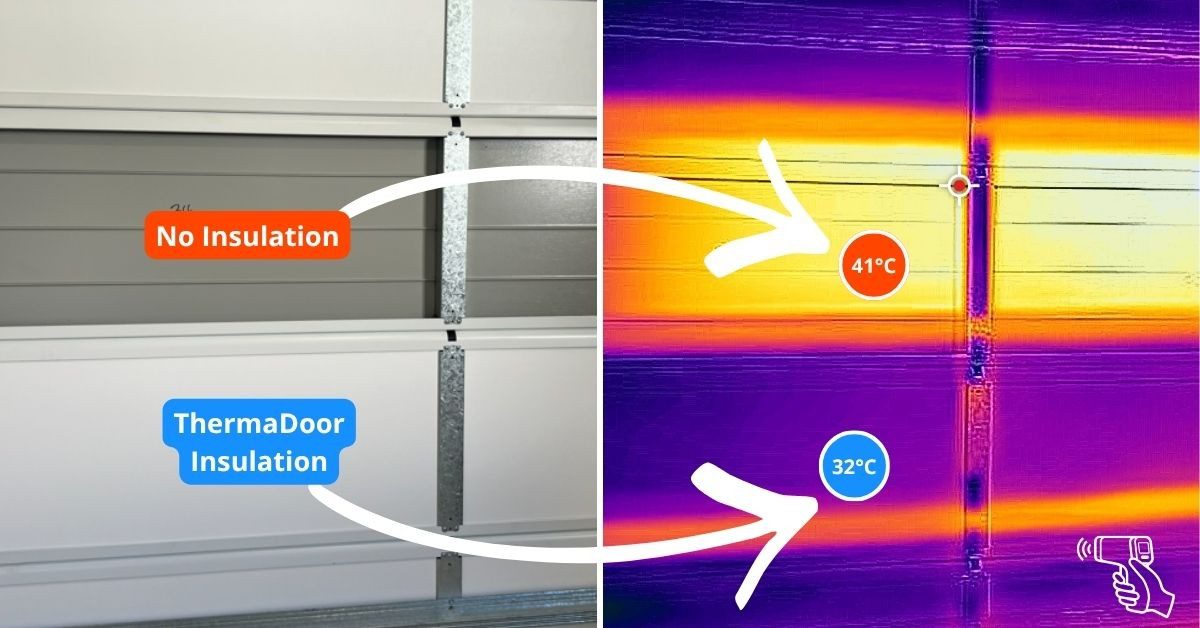
FLIR thermal image comparison showing garage door surface temperature — 41°C without insulation vs 32°C with ThermaDoor insulation
Home / Materials & Product Comparisons / Polyurethane vs EPS Garage Door Insulation: Which Is Right for Australian Homes?
Picture of Peter Hinton
Peter Hinton

Peter is a licensed builder with over 45 years of experience in the construction industry. In 2012, his expertise in energy efficient construction inspired the invention of ThermaDoor Premium garage door insulation - the original purpose made garage door insulation in Australia.

Polyurethane vs EPS Garage Door Insulation: Which Is Right for Australian Homes?

When researching garage door insulation in Australia, you will inevitably encounter two dominant materials: Polyurethane (PUR) and Expanded Polystyrene (EPS). Both are rigid foam plastics, both offer significant thermal resistance, and both are used extensively in the building industry.
However, a garage door is not a static wall. It is a large, moving, mechanical structure exposed to extreme temperature fluctuations. The insulation material you choose must balance thermal performance with weight, structural integrity, and long-term durability.
This guide provides a technical, objective comparison between polyurethane and EPS, explaining how each material performs specifically in a garage door application and what Australian homeowners need to know before making a decision.

Table of Contents

Understanding the Materials

Before comparing their performance, it is important to understand what these materials actually are.
 

Polyurethane (PUR)

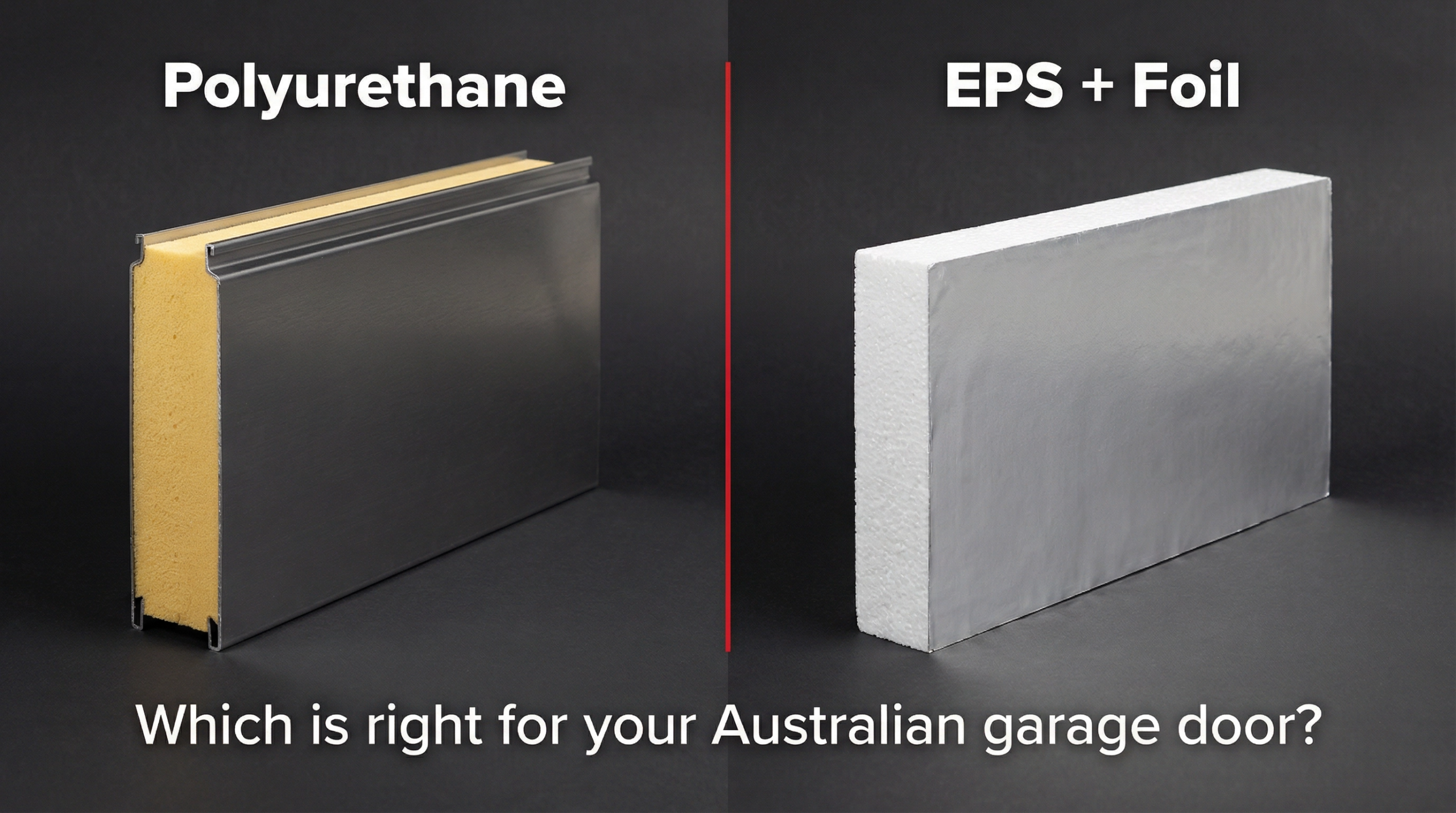
PUR is a dense, thermoset plastic foam. In the context of garage doors, it is typically injected as a liquid between two steel skins during the manufacturing process, where it expands and bonds to the metal, creating a solid composite panel. It is known for having a very high material R-value per millimetre.
 

Expanded Polystyrene (EPS)

EPS is a closed-cell, rigid foam board made by expanding polystyrene beads. It is lightweight, structurally stable, and highly resistant to moisture. In garage door applications, EPS is often cut into precision panels and retrofitted into existing sectional doors, or laminated with a reflective foil backing to enhance its thermal properties.

1. Thermal Performance and R-Values

The most common claim made about polyurethane is that it has a higher R-value than EPS. While this is true at a raw material level, the reality of how R-values work in a complete garage door assembly is more complex.

Material R-Value vs. Assembly R-Value

Polyurethane typically offers a material R-value of around R1.0 to R1.2 per 25mm of thickness. Standard EPS offers a material R-value of around R0.6 to R0.7 per 25mm. However, thickness matters. A premium retrofit EPS system like ThermaDoor is cut to 35mm thick to fill the entire cavity of the door panel. This 35mm thickness significantly boosts the overall thermal resistance compared to thinner products.
 
If you were insulating a perfectly sealed wall cavity, polyurethane would be the clear winner. However, a garage door is made of steel panels with hinges, gaps, and tracks. The steel itself acts as a thermal bridge, conducting heat directly past the insulation.
 
Because of this thermal bridging, the assembly R-value (the actual thermal performance of the entire door structure) is always lower than the raw material R-value. A polyurethane-injected door might claim an R-value of R3.0, but that is often just the theoretical value of the foam itself, not the tested performance of the door as a whole. ThermaDoor has verified assembly R-value R1.43 (winter) / R1.39 (summer).
 

The EPS and Foil Advantage

High-quality EPS garage door insulation systems, such as ThermaDoor, do not rely on the foam alone. They utilise construction-grade EPS laminated with a sisalation foil backing.
The EPS provides the conductive thermal resistance, while the highly reflective foil backing acts as a radiant barrier, reflecting up to 97% of radiant heat. This dual-action approach is particularly effective in the Australian climate, where radiant heat from the summer sun is the primary cause of overheated garages. Furthermore, independent engineering reports testing the complete assembly (door + insulation + air gaps) confirm that this system delivers genuine, dual-season verified thermal performance that meets Australian Standards (AS/NZS 4859.1 & 4859.2:2018).
 

2. Weight, Mechanical Strain, and AS/NZS 4505

The single biggest difference between polyurethane and EPS in a garage door application is weight.
 
Polyurethane is significantly denser than EPS. A steel garage door injected with polyurethane is exceptionally heavy. If you are buying a brand-new, factory-built insulated door, the manufacturer will supply a heavy-duty motor and specially calibrated springs designed to lift that specific weight.
 
However, if you are looking to insulate an existing garage door, weight becomes the most critical safety factor. Adding heavy polyurethane is not viable. The added weight will immediately strain your existing motor, stretch your springs, and potentially void your warranty.
 
EPS is exceptionally lightweight. A premium 35mm EPS panel system like ThermaDoor adds very little weight to the overall door structure. However, it is crucial to understand Australian Standards regarding door weight.
 
The AS/NZS 4505 Requirement: Under Australian Standard AS/NZS 4505 (Garage doors and other large access doors), the door must remain properly balanced for safe operation. This means that any modification that changes the weight of the door—even a lightweight EPS system—requires the springs to be checked and adjusted by a professional. A door that is not correctly balanced puts dangerous strain on the automatic opener and the springs themselves. While EPS is light enough that your existing springs can usually just be re-tensioned (rather than replaced entirely as they would with heavier materials), this professional adjustment is a mandatory safety step that should never be skipped.

3. Moisture and Vapour Barriers

Garages are prone to humidity and condensation, particularly in coastal Australian regions or in garages used as gyms or laundries.
 
Both polyurethane and EPS are closed-cell foams, meaning they are highly resistant to water absorption. However, moisture management is not just about the foam getting wet; it is about preventing condensation from forming on the inside of the steel door panels.
 
This is where the finishing of the insulation matters. Polyurethane-injected doors are sealed systems, which generally prevents condensation. For EPS systems, the inclusion of a foil backing is critical. The sisalation foil backing on ThermaDoor panels acts as a Class 2 vapour barrier. This prevents warm, moist air from inside the garage from reaching the cold steel of the door in winter, stopping condensation before it can form.

4. Installation and Retrofitting

Your choice between polyurethane and EPS will largely depend on whether you are buying a new door or upgrading your current one.

Polyurethane: Factory Only

Polyurethane insulation cannot be effectively retrofitted to a standard single-skin steel garage door. Because it is injected as an expanding foam, it requires a dual-skin door (steel on the front and back) to contain it. If you want polyurethane, you must purchase an entirely new, pre-insulated garage door.

EPS: The Retrofit Solution and New Build Cost Advantage

EPS panels are the industry standard for retrofitting existing garage doors. They can be precision-cut to fit the exact profile of your door panels.
 
Interestingly, this capability also provides a significant cost advantage for new builds. Instead of paying a premium for a factory-made polyurethane door from the builder, you can specify a standard steel door and request that a premium EPS system like ThermaDoor be included in your build specifications. By asking your builder or designer to include ThermaDoor as part of the construction process, you achieve comparable thermal performance for a fraction of the investment.
 
It is important to note how these panels are installed. Many cheap EPS kits rely on double-sided tape or glue, which inevitably fails in the extreme heat of an Australian summer. Professional-grade EPS systems use mechanical fixing—the panels are cut with specific tolerances to bow slightly and lock firmly behind the steel lips of the door, ensuring they never fall out, regardless of the temperature.

5. NatHERS 7-Star Energy Assessments

With the implementation of the NCC 2022 minimum 7-star energy rating requirements, the thermal performance of garage doors in new homes has come under strict scrutiny.

If you want your garage door insulation to contribute to your 7-star rating, it is crucial to ask your builder, designer, or energy assessor to include ThermaDoor in their assessments during the design stage. If you wait until after handover to insulate, it cannot be counted toward your home’s official energy compliance.
 
When energy assessors calculate a home’s NatHERS rating, they cannot simply input a manufacturer’s marketing claims. They require certified documentation proving the assembly R-value of the complete door system.
 
This is where premium EPS systems have a distinct advantage. ThermaDoor provides independent, certified thermal engineering reports that verify the total system R-value. By specifying ThermaDoor early in the process, these reports can be directly submitted to your energy assessor to help achieve the mandatory 7-star rating. Surprisingly, even some expensive factory-built polyurethane doors struggle to provide this level of certified, assembly-specific documentation for NatHERS compliance.
 

Summary: Which Should You Choose?

FeaturePolyurethane (PUR)Expanded Polystyrene (EPS)
Best ApplicationBuying a brand-new doorRetrofitting an existing door
WeightHeavy (requires specific motors/springs)Lightweight (spring re-tensioning per AS/NZS 4505)
Thermal ResistanceExcellent material R-valueExcellent assembly R-value (when foil-backed)
Moisture ResistanceHighHigh (Foil acts as Class 2 Vapour Barrier)
CostHigh (requires new door purchase)Highly cost-effective
If you are building a new home and have the budget for a premium, factory-built dual-skin door, a polyurethane-injected door is an excellent choice.
However, if you want to insulate your existing garage door to create a more comfortable, usable space without spending thousands of dollars on a complete door replacement, a construction-grade, foil-backed EPS system is the undisputed best choice for Australian conditions.

Ready to Upgrade Your Garage?

Before you make a decision, make sure you know exactly what to look for. Download the ThermaDoor Buyer’s Checklist to understand the seven crucial questions you need to ask about R-values, Australian Standards, and installation safety.
 
Polyurethane vs EPS foil-backed garage door insulation comparison for Australian homes

ThermaDoor Installation

Let our experts handle installation for you
Or Ask Us A Question

Call, text, or send an enquiry below to see if we have an installer in your area.

Make an Enquiry