Rubber Peel-and-Stick Garage Door Insulation: What You Need to Know Before You Buy

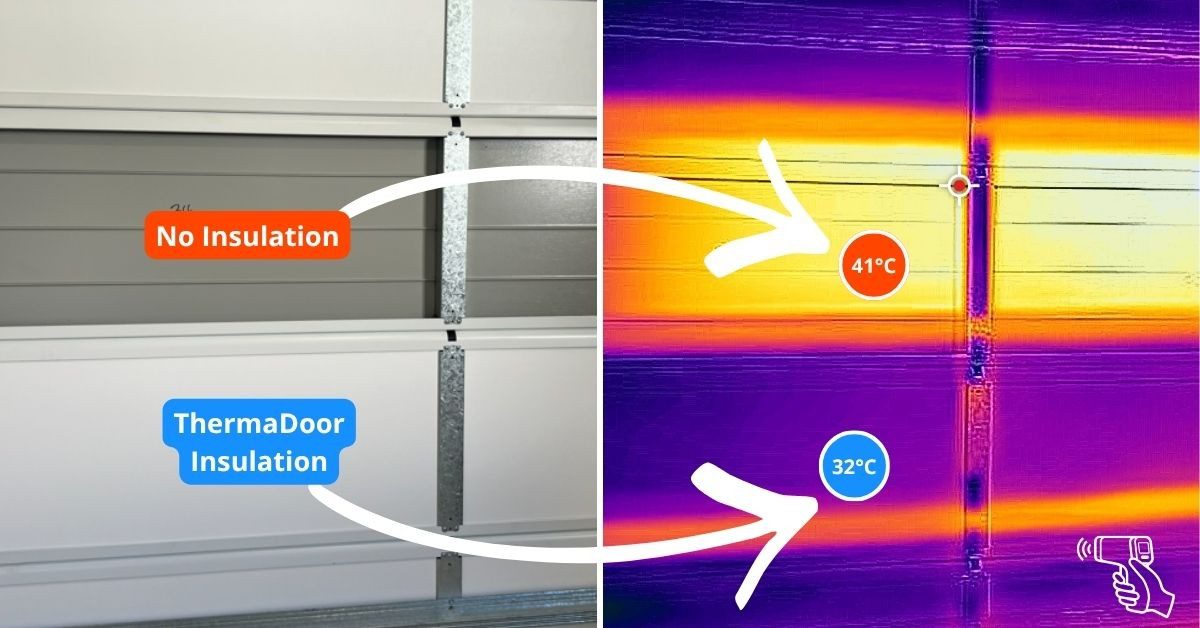
FLIR thermal image comparison showing garage door surface temperature — 41°C without insulation vs 32°C with ThermaDoor insulation
Home / Materials & Product Comparisons / Rubber Peel-and-Stick Garage Door Insulation: What You Need to Know Before You Buy

Rubber Peel-and-Stick Garage Door Insulation: What You Need to Know Before You Buy

A new type of garage door insulation has been appearing in the Australian market: rubber-based, peel-and-stick sheets that you glue directly to the face of your garage door. They are easy to find online, simple to install, and marketed as a premium solution.
 
Before you buy, there are four things worth understanding. None of them appear in the product listings.

1. This Material Was Not Designed for Garage Doors

The rubber used in these products is a closed-cell elastomeric foam — the same material used to wrap pipes in commercial buildings. One leading product in this category describes its own technology on its website as being “commonly used in pipe lagging applications.”
 
Pipe lagging is designed to insulate stationary, cylindrical pipes in controlled indoor environments — HVAC systems, refrigeration lines, and plumbing. It is a legitimate product in that application.
 
A garage door is not a pipe. It is a large, moving, profiled steel panel exposed to full Australian sun, daily temperature swings of 40°C or more, and constant mechanical articulation. The thermal performance of pipe lagging rubber is calculated for pipe geometry, at a specific thickness, in a controlled interior environment. None of those conditions apply to a garage door.
 
No independent engineering report has been published showing the assembly R-value of this product in a garage door application. Without one, there is no way to independently verify what thermal performance — if any — it actually delivers on your door.
 
What to ask any insulation supplier: “Can you provide an independently verified assembly R-value for this product installed in a garage door?” If they cannot, their thermal performance claims are unverified. 
 

2. Your Garage Door Is Not a Flat Surface — and That Creates a Serious Problem

This is the most important thing to understand about the peel-and-stick installation method — and it is something the product’s marketing does not address.
 
Australian sectional garage doors are not flat sheets of steel. They are manufactured with pressed profiles, ribs, and patterns pressed into the steel to give the door strength and visual character. These impressions are typically 4–5mm deep.
 
When you glue a flat rubber sheet across the face of a profiled door panel, it cannot sit flat against every part of the surface. It rides over the pressed profiles, creating sealed air pockets between the steel and the rubber.
 
These air pockets cause two serious problems.
 

The Moisture Problem

When a sealed air pocket sits against cold steel, condensation forms at the steel surface. Because the rubber seals the pocket from above, that moisture has nowhere to go. Over time, trapped moisture against steel causes corrosion and deterioration — from the inside, where you cannot see it.
 
This is a well-understood failure mode in the industrial insulation industry. It is the reason professional insulation engineers design systems specifically to prevent moisture from becoming trapped against metal surfaces.
 
The National Construction Code 2025 (NCC 2025) has introduced updated condensation management requirements for Australian buildings — see the ABCB guidance here — because trapped moisture against building materials is a recognised and growing problem in the Australian climate. While garage doors are not directly covered by these provisions, the principle is the same: sealing moisture against steel is a risk that requires a designed response, not an afterthought.
 

The Peeling Problem

Air expands when it heats up. On a summer day in Australia, the surface of a dark steel garage door can reach 70°C or more. The air trapped in those 4–5mm voids heats up and expands, pushing outward against the rubber sheet above it.
 
Every hot day, the air expands and pushes the rubber a little further off the door. Every time the door cools overnight, the adhesive bond has been stretched a little more. The voids grow larger with each cycle. Larger voids trap more air. More air means more pressure on the next hot day. It is a compounding failure — and it is a predictable consequence of gluing a flat sheet over a profiled steel surface that heats to extreme temperatures daily.
 

3. It Adds Twice the Weight of Purpose-Built Insulation

The rubber product discussed in this article adds approximately 13–16kg to a standard double garage door — based on 16 sheets, as stated in the product’s own FAQ. ThermaDoor adds approximately 7kg to the same door.
 
That difference matters because your garage door springs and motor are calibrated at the factory to the precise weight of that specific door.
 

The Hidden Safety Risk

When you add 16kg to a door without adjusting the motor’s force limits (also known as obstacle detection sensitivity), you create a significant safety hazard.
The motor is programmed to reverse if it hits an obstacle — a car, a pet, or a person. But if the door is now 16kg heavier, the motor has to push harder just to move it normally. If it hits an obstacle on the way down, the uncalibrated force limit may not trigger the safety reversal in time, allowing the full weight of the door and motor force to bear down on the obstacle.
 
This is why Australian Standard AS/NZS 60335.2.95 — which governs garage door operators — and manufacturer manuals from brands like Merlin explicitly require a safety reversal test (the 40mm block test) after any modification to a door.
 
One rubber insulation product states in its FAQ that spring adjustment is “usually unnecessary” after installation, and suggests a simple DIY test to check. This advice is dangerously misleading. A door that opens with 16kg of added weight is not necessarily a balanced or safe door — it may simply mean the motor is powerful enough to overcome the imbalance, masking the fact that the safety force limits are now completely incorrect.
 
If a door with uncalibrated force limits causes injury or damage, it could potentially compromise your home insurance or liability coverage. A spring balance and force limit recalibration by a qualified technician is the only safe way to proceed after adding 16kg to a garage door. ThermaDoor recommends a professional service after every installation. 

4. The R-Value Question

R-value is the standard measure of thermal resistance. The higher the R-value, the better the insulation. But there are two very different types of R-value — and the difference is critical.
 
Material R-value measures the insulation material on its own, in a laboratory. It does not account for how the product is installed, the steel door panels it is attached to, or the thermal bridges created by the door’s steel frame.
 
Assembly R-value measures the complete installed system — insulation, door panels, air gaps, and real-world geometry. Because steel is an excellent conductor of heat, the entire door frame acts as a thermal bridge that significantly reduces real-world performance below the material figure. Assembly R-value is what determines how your garage actually performs.
 
The rubber sheeting products currently on the Australian market do not publish an assembly R-value for the garage door application. The product is glued directly to the steel face with no designed air gap, which eliminates any reflective benefit and means every steel upright is an uninsulated thermal bridge.
 
ThermaDoor’s assembly R-values — R1.43 in winter and R1.39 in summer — are independently verified under AS/NZS 4859.1/.2:2018 and documented in an engineering report available on request.

Side-by-Side Comparison

Factor Rubber Peel-and-Stick Sheets ThermaDoor Premium EPS System
Original design application Pipe lagging (HVAC, refrigeration, plumbing) Purpose-made for Australian sectional garage doors
Installation method Glued directly to steel face — no mechanical fixing Retained within structural door framework — no glue required
Profile void risk Yes — flat sheet cannot conform to 4–5mm pressed door profiles, creating sealed air pockets that trap moisture and expand under heat No — panels sit within the door framework, not glued across the profiled face
Air gap None Yes — designed air gap provides additional thermal buffer and reduces condensation and corrosion risk
Radiant heat barrier None Yes — sisalation foil backing reflects radiant heat
Vapour barrier None Yes — Class 2 vapour barrier (sisalation foil) reduces moisture risk
Door movement accommodation No — glued sheet restricts the door's natural thermal expansion and contraction Yes — panel system accommodates the door's natural movement
Condensation risk High — no air gap, no vapour barrier, sealed profile voids trap moisture against steel Low — air gap, foil vapour barrier, and panel system work together to manage moisture
Adhesive failure risk Yes — trapped air in profile voids expands under heat, progressively lifting product off the door No — no adhesive bond to steel
Assembly R-value Not published — no independent engineering report for the garage door application R1.43 Winter / R1.39 Summer — independently verified under AS/NZS 4859.1/.2:2018
Added weight (standard double door) 13–16kg ~7kg
Spring & motor safety compliance Claims spring adjustment "usually unnecessary" — does not address motor force limit recalibration (safety hazard) Professional service recommended after installation — consistent with AS/NZS 4505:2012 and AS/NZS 60335.2.95
Interior finish Black or grey rubber — dark surface absorbs radiant heat back into the garage space White laminated vinyl — easy clean and brightens the garage interior

The Verdict

Rubber peel-and-stick sheets are a pipe lagging product being sold as garage door insulation. In their intended application — wrapping cylindrical pipes at a calculated thickness in a controlled indoor environment — they serve a legitimate purpose. That application is not a garage door.
 
Applied as a flat sheet to the profiled face of a steel sectional door in full Australian sun, this product creates sealed air pockets that trap moisture against the steel, generates progressive adhesive failure through daily thermal cycling, adds twice the weight of purpose-built alternatives, and provides no independently verified assembly R-value for the garage door application.
 
Most concerningly, the marketing advice surrounding its installation dismisses the very real safety hazard of adding 16kg to a door without recalibrating the motor’s safety reversal limits.
 
At a price point comparable to purpose-built alternatives — see our full breakdown of garage door insulation costs in Australia — there is no performance or safety justification for choosing a product that creates these conditions.
 
Before purchasing any garage door insulation, ask for the assembly R-value and the independent engineering report that supports it. If a supplier cannot provide one, look for a product that can.
 

Technical Notes

The following standards and references support the claims made in this article:
 
  • ASTM C534/C534M — Standard Specification for Preformed Flexible Elastomeric Cellular Thermal Insulation in Sheet and Tubular Form. Governs performance requirements for elastomeric rubber insulation in its intended pipe and sheet applications.
  • 2025 ASHRAE Handbook — Fundamentals, Chapter 23: Insulation for Mechanical Systems — Documents the purposes and performance parameters of pipe insulation, including thermal, acoustic, and condensation control functions.
  • NACE Standard SP0198 — The Control of Corrosion Under Thermal Insulation and Fireproofing Materials. Documents the mechanism by which moisture trapped under insulation against metal surfaces causes corrosion (Corrosion Under Insulation / CUI).
  • AS/NZS 4505:2012 — Garage Doors and Other Powered Vehicular Access Control Systems. Requires the door to continue operating within its designed parameters after any modification.
  • AS/NZS 60335.2.95 — Household and similar electrical appliances — Safety — Particular requirements for drives for vertically moving garage doors for residential use. Outlines the safety reversal requirements (e.g., reversing on contact with a 40mm object) which are compromised if force limits are not recalibrated after adding weight.
  • AS/NZS 4859.1/.2:2018 — Materials for the Thermal Insulation of Buildings. The standard under which ThermaDoor’s assembly R-values are independently verified.
  • NCC 2025, Volume One Part F8 / Housing Provisions Standard — Updated condensation management provisions for Australian buildings. ABCB guidance.

Frequently Asked Questions

Is rubber peel-and-stick garage door insulation safe?

Rubber peel-and-stick garage door insulation raises a significant safety concern that is rarely disclosed. Adding 13–16kg to a standard double garage door changes the door’s weight balance and requires recalibration of the motor’s force limits and safety reversal settings. Under AS/NZS 60335.2.95, garage door operators must reverse on contact with a 40mm obstacle. If force limits are not recalibrated after adding weight, the motor may not trigger a safety reversal in time, creating a risk of injury. A qualified garage door technician should inspect and recalibrate the door after any insulation is added.

No independently verified assembly R-value has been published for rubber peel-and-stick garage door insulation in a garage door application. While the rubber material itself has some thermal resistance, assembly R-value — which measures the complete installed system including the steel door, thermal bridges, and air gaps — is the only meaningful measure of real-world performance. Without an independent engineering report confirming the assembly R-value under AS/NZS 4859.1/.2:2018, any thermal performance claims for this product type cannot be independently confirmed.

Australian sectional garage doors have pressed profiles and ribs typically 4–5mm deep. When a flat rubber sheet is glued across a profiled door panel, it cannot sit flush against the entire surface, creating sealed air pockets over the pressed profiles. In summer, the surface of a dark steel garage door can reach 70°C or more. The air trapped in those pockets expands under heat, pushing the rubber sheet away from the door. Each thermal cycle stretches the adhesive bond a little further. Over time, the voids grow larger and the product progressively lifts off the door.

The best garage door insulation in Australia is a purpose-built system with an independently verified assembly R-value under AS/NZS 4859.1/.2:2018. ThermaDoor is the original purpose-made garage door insulation manufactured in Australia, with assembly R-values of R1.43 in winter and R1.39 in summer, independently verified and documented in an engineering report. Unlike products adapted from pipe lagging or wall insulation, ThermaDoor is engineered specifically for the thermal, mechanical, and moisture demands of an Australian sectional garage door.

Yes — any insulation that adds weight to a garage door affects the spring balance. Garage door springs are calibrated at the factory to the precise weight of the door. Adding insulation changes that weight and can affect both the spring tension and the motor’s force limit settings. A spring balance check and motor force limit recalibration by a qualified technician is recommended after any garage door insulation installation, consistent with AS/NZS 4505:2012 and AS/NZS 60335.2.95.
Picture of Peter Hinton
Peter Hinton

Peter is a licensed builder with over 45 years of experience in the construction industry. In 2012, his expertise in energy efficient construction inspired the invention of ThermaDoor Premium garage door insulation - the original purpose made garage door insulation in Australia.

ThermaDoor is the manufacturer of the products discussed in this article and has a commercial interest in their sale. While every effort has been made to ensure the accuracy of the information presented, readers are encouraged to conduct their own research and consult qualified professionals before making purchasing decisions. All R-values cited are independently verified assembly R-values under AS/NZS 4859.1/.2:2018.

ThermaDoor Installation

Let our experts handle installation for you
Or Ask Us A Question

Call, text, or send an enquiry below to see if we have an installer in your area.

Make an Enquiry