What Is Garage Door Insulation? A Complete Australian Guide

FLIR thermal image comparison showing garage door surface temperature — 41°C without insulation vs 32°C with ThermaDoor insulation
Home / Climate & Comfort Guides / What Is Garage Door Insulation? A Complete Australian Guide

What Is Garage Door Insulation? A Complete Australian Guide

Walk into an uninsulated garage on a hot Australian afternoon and the temperature tells you everything. Steel absorbs solar energy fast and radiates it straight back into the space — and into any room sharing a wall with the garage. Garage door insulation is the most direct way to address that problem. But understanding what it actually is, how it works, and why the product you choose matters more than most people realise is worth taking the time to get right.
What Is Garage Door Insulation?

Garage door insulation is a thermal barrier fitted to the interior face of a garage door to reduce heat transfer between the outside environment and the interior of the garage.
 
It works in both directions. In summer, it slows the movement of heat from a sun-baked door into the garage and any adjacent living space. In winter, it retains warmth inside the garage rather than allowing it to bleed out through the door overnight and through cold mornings. The result is a more stable, more comfortable temperature inside the garage year-round.

Summer Benefits: Keeping the Heat Out

In the Australian climate, the summer benefit is the most immediately obvious. A steel garage door facing west or north can reach surface temperatures exceeding 70°C on a hot afternoon. Without insulation, that heat radiates directly into the garage and through any shared wall into the living space beyond.
 
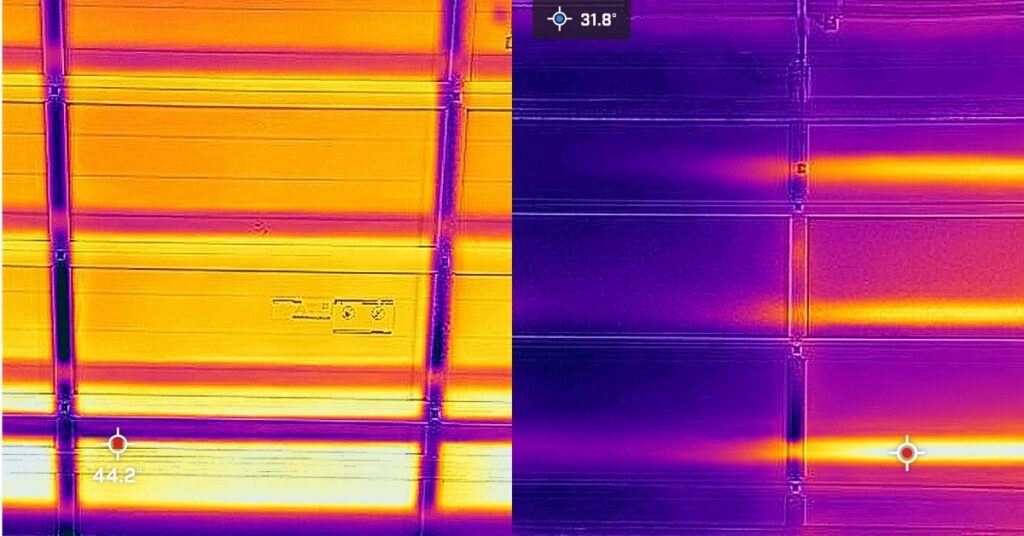
Garage door insulation significantly reduces the rate at which that heat enters the space. Independent thermal imaging data shows that an insulated ThermaDoor panel maintains a surface temperature dramatically lower than the uninsulated steel door beside it — reducing the radiant heat load on the garage interior and any adjacent rooms.
 
For households where the garage is used as a workshop, gym, or kids’ play area, the difference between an insulated and uninsulated door in summer is the difference between a usable space and an unusable one. For homes with an attached garage sharing a wall with a living area or bedroom, it directly reduces the cooling load on the air conditioning system.
FLIR thermal image showing uninsulated garage door at 44.2°C compared to ThermaDoor insulated door at 31.8°C

FLIR thermal imaging: uninsulated garage door (left) 44.2°C — ThermaDoor insulated door (right) 31.8°C. Same day, same conditions.

Winter Benefits: Retaining Warmth

The winter benefit is less visible but equally significant. A steel garage door is one of the largest uninsulated surfaces in most Australian homes. On a cold morning, it acts as a radiator in reverse — drawing warmth out of the garage and into the cold air outside.
 
For households that use the garage as a workspace, this means tools, vehicles, and stored items are exposed to cold and damp overnight. For homes with a garage underneath a bedroom or adjacent to a living area, the cold garage acts as a heat sink that increases the heating load on the home.
 
Insulating the garage door reduces this heat loss, stabilising the temperature inside the garage and reducing the thermal impact on adjacent living spaces.

How Does Garage Door Insulation Work?

Insulation works by slowing the transfer of heat. The rate at which heat moves through a material is measured by its R-value — the higher the R-value, the greater the resistance to heat flow.
 
For garage doors, there are two R-values to understand:
 
Material R-value is the thermal resistance of the insulation material itself, measured in a laboratory under controlled conditions. This number is often quoted by insulation sellers because it is always higher than the real-world figure.
 
Assembly R-value is the thermal resistance of the insulation as installed in the actual application — accounting for the material, the air gap, the framing, and the thermal bridging of the structure. This is the number that reflects real-world performance.
 
For a garage door, the assembly R-value is the only meaningful figure. ThermaDoor’s independently verified assembly R-values are R1.43 (winter) and R1.39 (summer) under AS/NZS 4859.1/.2:2018.

What Is ThermaDoor Made From?

ThermaDoor panels are built from a construction-grade polystyrene core — not the lightweight foam used in packaging, but the denser, higher-performance grade used in the building industry. Multiple layers are laminated together into a single cohesive panel, which gives the product a characteristic that most insulation materials cannot match: genuine flexibility.
 
Because the layers are bonded into one unit, the panel bends and flexes with the door through every open and close cycle. It will not crack during installation, will not delaminate over time, and will not develop stress fractures from the repeated articulation that a sectional garage door experiences daily. ThermaDoor panels are exceptionally lightweight — adding only around 7kg to a standard double garage door springs and motor system.
 
The panel faces are finished with a laminated white vinyl face and a sisalation foil backing — the same reflective foil material used to wrap houses for thermal protection — which acts as a Class 2 vapour barrier and adds a radiant barrier to the thermal resistance of the core.

The Air Gap: Why Installation Method Matters

ThermaDoor panels are installed with a deliberate air gap between the panel and the steel door surface. This is not incidental — it is a core part of the thermal system. The air gap adds a further layer of thermal resistance, improving the overall assembly R-value beyond what the panel alone would achieve.
 
But the air gap does more than improve thermal performance. It prevents condensation from forming on the inner face of the door. When warm, humid air meets a cold steel surface, moisture condenses — and that moisture is the starting point for mould growth and rust. By maintaining an air gap, the steel surface is kept away from direct contact with the insulation panel and the humid air in the garage, eliminating the conditions that cause condensation to form.
 
This is also why any insulation product that is glued directly to the door creates long-term problems. Adhesive products eliminate the air gap, trap moisture against the steel, and fight the door’s natural movement and thermal expansion. A sectional garage door flexes and articulates every time it opens and closes and expands and contracts with temperature changes throughout the day. Anything glued to the door surface is fighting that movement — and over time, the adhesive fails, the product peels, and the door is left worse than before.

Why Most Garage Door Insulation Is Not Purpose-Built

Most insulation products sold for garage doors were not designed for the application. They are materials borrowed from other industries — wall insulation, roof insulation, pipe lagging — adapted for a use they were never engineered to handle. PIR (polyisocyanurate) panels are one example — see how PIR compares to purpose-built garage door insulation.
 
A garage door is not a wall. It is not a floor. It is certainly not a pipe. It is a large, heavy, moving mechanical system that operates under strict structural tolerances, articulates hundreds of times a year, and is exposed to the full range of Australian weather conditions.
 
Purpose-built garage door insulation accounts for all of this. It is lightweight enough not to overload the spring system. It is flexible enough to move with the door without cracking or delaminating. It is installed with an air gap that prevents condensation and protects the door. And it is independently tested to Australian standards so that the R-value quoted is the R-value delivered.
 
For a deeper look at why wall insulation and borrowed materials fail in this application, see our article: Wall Insulation Is Not Garage Door Insulation.

Summary

Garage door insulation is a thermal barrier that reduces heat transfer through your garage door in both summer and winter. In the Australian climate, it is one of the highest-impact home improvements available for homes with an attached or integral garage.
 
Not all garage door insulation is equal. Most products on the market were not designed for the application — they are materials borrowed from other industries that do not account for the mechanical movement, thermal expansion, and structural demands of a sectional garage door. Products glued directly to the door surface create condensation, mould, and rust problems, and fight the door’s natural movement over time.
 
Purpose-built insulation, installed with a deliberate air gap and independently tested to Australian standards, is the only reliable solution.

Frequently Asked Questions

Does garage door insulation make a noticeable difference?

Yes — particularly in summer. The difference between an insulated and uninsulated garage door on a hot afternoon is immediately apparent. For garages used as living or working spaces, the improvement in comfort is significant. For attached garages, it also reduces the thermal load on adjacent rooms.

It reduces the heat load on any air conditioning system serving the garage or adjacent spaces, which reduces energy consumption. The extent of the saving depends on how the garage is used and how well the rest of the space is insulated.

Yes. Insulation slows heat transfer in both directions. In winter it retains warmth inside the garage rather than allowing it to escape through the door.

Always ask for the assembly R-value, not the material R-value. The assembly R-value reflects real-world performance in the installed application. ThermaDoor’s independently verified assembly R-values are R1.43 (winter) and R1.39 (summer) under AS/NZS 4859.1/.2:2018.

Yes. Purpose-built retrofit panels like ThermaDoor are designed to be installed on existing sectional garage doors without structural modification.

If you are an NDIS participant or support coordinator, see our dedicated NDIS Home Modifications page.

ThermaDoor is Australia’s original purpose-built garage door insulation — independently tested, Australian made, and designed specifically for Australian conditions since 2012. To find out more or get a quote, visit thermadoor.com.au or call 07 5452 4378.

ThermaDoor is an independent Australian manufacturer. All R-values cited are independently verified assembly R-values under AS/NZS 4859.1/.2:2018.

Picture of Peter Hinton
Peter Hinton

Peter is a licensed builder with over 45 years of experience in the construction industry. In 2012, his expertise in energy efficient construction inspired the invention of ThermaDoor Premium garage door insulation - the original purpose made garage door insulation in Australia.

ThermaDoor is the manufacturer of the products discussed in this article and has a commercial interest in their sale. While every effort has been made to ensure the accuracy of the information presented, readers are encouraged to conduct their own research and consult qualified professionals before making purchasing decisions. All R-values cited are independently verified assembly R-values under AS/NZS 4859.1/.2:2018.

ThermaDoor Installation

Let our experts handle installation for you
Or Ask Us A Question

Call, text, or send an enquiry below to see if we have an installer in your area.

Make an Enquiry