How Much Does Garage Door Insulation Cost in Australia?

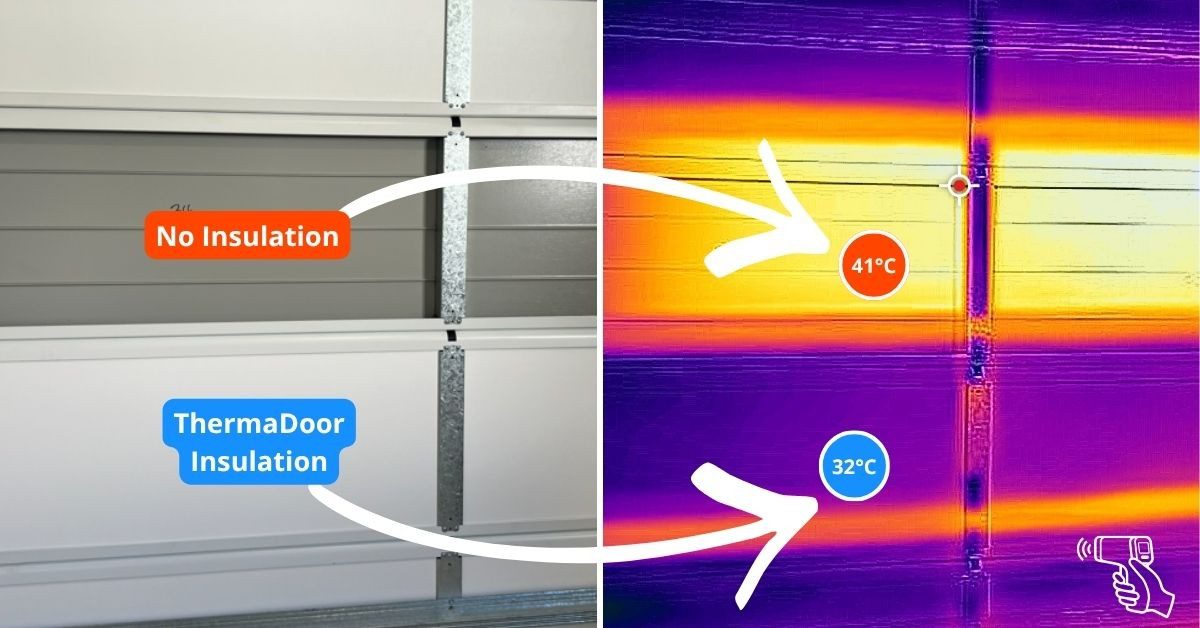
FLIR thermal image comparison showing garage door surface temperature — 41°C without insulation vs 32°C with ThermaDoor insulation
Home / Australian Standards & Compliance / How Much Does Garage Door Insulation Cost in Australia?

How Much Does Garage Door Insulation Cost in Australia?

If you have been searching for garage door insulation cost in Australia, you have probably noticed that prices vary widely and are rarely listed clearly. This guide breaks down what you can expect to pay, what drives the difference in cost, and — critically — why price alone tells you very little about what you are actually getting.
 
The short answer: for a standard double sectional door (16 panels), DIY garage door insulation in Australia typically costs between approximately $460 and $700 before freight, depending on the product type. Professional installation adds labour and in some cases significantly increases the total. But the number on the price tag is only part of the story. Two products at a similar price point can deliver very different results. In some cases, a product at the higher end of the market can perform worse than one at the lower end.

What Affects the Cost of Garage Door Insulation in Australia?

Several factors determine the final price of a garage door insulation job. Understanding them helps you ask the right questions before you commit.
 
Door size is the most obvious variable. A standard single garage door (approximately 2,400mm wide) requires fewer panels than a standard double door (approximately 4,800mm wide). Most Australian homes have double sectional doors, so that is the most common reference point for pricing. Larger or non-standard doors will cost more, and some suppliers charge significantly more for oversized panels.
 
Product type has a significant effect on both price and performance. Not all garage door insulation is the same material, and the material determines the thermal resistance (R-value) you actually get. Rubber peel-and-stick sheets, EPS (expanded polystyrene) panel systems, graphite polystyrene panels, and PIR (polyisocyanurate) foam panels all sit at different price points and deliver very different results. As the market comparison below shows, price and performance do not always move in the same direction.
 
DIY versus professional installation is the other major cost lever. DIY kits cost less upfront, but professional installation ensures the panels are fitted correctly, the door remains balanced, and the result performs as expected. DIY is a practical option for homeowners with basic handyman skills and a day to spare — provided a qualified garage door technician is booked to check and rebalance the springs after installation. Professional supply and install is the better path for older or non-standard doors, or where NDIS compliance requires it.

Standard Double Door Pricing: What the Market Currently Looks Like

The table below shows indicative DIY pricing for a standard double door (16 panels) across the main product types currently available in Australia. All prices are before freight. Freight can add significantly to the total depending on your location, so always confirm the delivered price before purchasing.

← Scroll to see full table

Product Type Approx. DIY Price (Standard Double Door, Before Freight) Notes
Foil-only sheeting (e.g. hardware store rolls) ~$100–$215 On their own R-values are as low as R0.1. Requires an air gap to function; when glued directly to steel with no air gap, provides negligible thermal resistance. R-values quoted are based on wall and roof testing environments — a vastly different application to a garage door — and may be overstated for this use.
EPS panel kits (basic, via trade suppliers) From ~$350–$460 R-values are typically based on wall or roof testing, not garage door assembly. No independent assembly R-value for the garage door application.
ThermaDoor Premium (purpose-built EPS system) ~$640 Independently verified assembly R-value R1.43 (winter) / R1.39 (summer) under AS/NZS 4859.1/.2:2018 — tested as a complete garage door assembly, not a wall or roof.
Rubber peel-and-stick sheets ~$669 Pipe lagging material adapted for garage doors. R-values based on pipe lagging application, not garage door assembly. No independent assembly R-value for the garage door application. See note below.
PIR foam panels ~$700 Construction-grade material designed for roofing and walls. R-values quoted are material R-values from those applications — not independently verified as a garage door assembly R-value. See note below.
What this comparison reveals: ThermaDoor is not the cheapest option on the market, but it is also not the most expensive. A purpose-built, independently tested product with a verified assembly R-value sits at a similar or lower price point than products using borrowed construction materials with no garage-door-specific performance data. In this category, a higher price is not a reliable indicator of better performance.
For current pricing and panel size options, visit our shop page to view without obligation to purchase.

Professional Installation Pricing

For professionally installed garage door insulation, pricing varies significantly by product and provider. As a general guide, professional installation in Australia typically ranges from approximately $700 to $1,200 or more for a standard double sectional door, depending on location, door size, and product.
 
ThermaDoor professional installation is available through our distributor network, which covers Brisbane, the Sunshine Coast, Gold Coast, Hervey Bay, Sydney, Melbourne, Perth, Adelaide, Canberra, and Hobart. Contact us or your local distributor for a current quote specific to your door.
 
Professional installation is particularly recommended for older doors where panel dimensions may not be perfectly standard, doors with existing damage or wear that should be assessed before insulation is added, and NDIS-funded modifications where professional installation is required for compliance.

Why Price Is Not a Reliable Guide in This Category

The garage door insulation market in Australia includes products that range from purpose-built systems with independent engineering data to construction materials repurposed for an application they were never designed for. A higher price does not guarantee better performance. What matters is whether the product has been independently tested for the specific application of a moving, steel, sectional garage door.
 
There are a few things worth watching for when comparing products and quotes.
 
Foil-only products are often among the cheapest options and consistently among the worst performers. Reflective foil insulation requires an air gap to function. When it is glued directly to a metal garage door with no air gap, it provides negligible thermal resistance regardless of what the marketing claims. We have written about this in detail in our article on failed reflective foil insulation.
 
Graphite polystyrene panels are marketed in some quarters as a premium upgrade over standard EPS. The reality is more nuanced. Graphite-doped polystyrene (GPS) does offer a marginal improvement in thermal resistance compared to plain white EPS of the same thickness, but GPS absorbs solar heat. Peer-reviewed research confirms that GPS surfaces reach substantially higher temperatures under direct solar exposure than plain EPS — the opposite of what you want on a steel door already absorbing radiant heat. GPS also has no foil barrier to reflect radiant heat from the door surface. For a full analysis, see our article on graphite garage door insulation. When a product marketed as “premium” cannot provide an independently verified assembly R-value for the garage door application, the premium label warrants scrutiny.
 
PIR foam panels are a genuine high-performance insulation material in the commercial roofing and wall applications they were designed for. In a garage door, the picture is more complicated. PIR is a brittle material under tension; a garage door flexes and articulates every time it operates. PIR also requires special precautions in high-humidity, high-thermal-cycling environments — precisely the conditions a steel garage door experiences daily. PIR sellers in Australia almost exclusively quote a material R-value, not an assembly R-value for the garage door. For a full breakdown, see our article on PIR garage door insulation in Australia.
 
Rubber peel-and-stick sheets are among the most concerning products currently being marketed as garage door insulation in Australia. These products are adapted from pipe lagging — a material designed to wrap stationary pipes in commercial buildings, not to insulate a large, moving, steel door exposed to full Australian sun. The problems are fundamental: no air gap, no foil barrier to address radiant heat, and no independently verified assembly R-value for the garage door application. A standard double door kit adds approximately 13 to 16kg to the door (as stated in the supplier’s own FAQ), which places the door at risk of operating outside the parameters required by AS/NZS 4505:2012 unless springs are professionally rebalanced. Advice suggesting that spring adjustment is “usually unnecessary” after adding 13 to 16kg to a door — without a qualified technician assessing the specific door — is not consistent with the intent of that standard. It is also a non-breathable material glued directly to steel, which raises condensation concerns in climates with significant temperature variation. We examine this in detail in our article on rubber peel-and-stick garage door insulation.
 
Material R-values quoted without an assembly R-value are a warning sign regardless of product type. A material R-value tells you how the insulation performs in isolation, in a laboratory, with no steel frame, no thermal bridging, and no real-world conditions. An assembly R-value tells you how the complete installed system performs in your actual garage door. ThermaDoor is independently tested to R1.43 (winter) / R1.39 (summer) as an assembly R-value under rubber peel-and-stick garage door insulation. That is the number that reflects real-world performance.
 
Products with no engineering report should be treated with caution. Any credible insulation product should be able to provide independent test data on request. ThermaDoor’s Independent Performance Report is available on the website.
 

Is the Cost Worth It?

For most Australian homeowners, yes. A garage door is typically the largest uninsulated surface on the home. A standard steel garage door has an effective R-value of R0.0, meaning it provides zero resistance to heat or cold transfer. In summer, an uninsulated door can radiate temperatures exceeding 44 degrees Celsius into the adjoining space. In winter, it acts as a heat sink, drawing warmth out of the home.
 
The thermal improvement from a quality insulation system is measurable, not just noticeable. Our FLIR thermal imaging data shows a surface temperature reduction from 44.7°C to 30.8°C on an ordinary autumn afternoon at 28°C ambient temperature. In summer, the performance gap is significantly larger.
 
For a full analysis of the value case, read our article: Is Garage Door Insulation Worth It in Australia?

A Note on Spring Balance

Regardless of which product you choose, we recommend having your door springs checked and adjusted by a qualified technician after installation. Springs are calibrated to the precise weight of the door at the factory. Adding any weight changes that calibration. Failure to rebalance springs after adding insulation can strain the motor, increase wear on lifting cables, and take the door outside the operational tolerances required by AS/NZS 4505:2012. This applies across all product types, including ThermaDoor.
 

NDIS and Aged Care Funding

If you or a family member is an NDIS participant or receiving aged care support, garage door insulation may be fundable through your plan. ThermaDoor installations can qualify as a Minor Home Modification under NDIS Capital Supports, and may also be eligible under the Support at Home AT-HM Scheme for eligible aged care recipients.
 
Visit our NDIS home modifications page for full details, including information for occupational therapists and support coordinators.

Get a Quote

The best way to get an accurate cost for your specific door is to contact our team directly. We can provide a detailed, itemised quote based on your door dimensions and location, with no obligation.
 

Frequently Asked Questions

How much does garage door insulation cost in Australia?

For a standard double door (16 panels), DIY garage door insulation in Australia currently ranges from approximately $460 to $700 before freight, depending on the product type. Professional installation typically ranges from approximately $700 to $1,200 or more for a standard double sectional door, depending on location and product. Always confirm the delivered price directly with suppliers, as freight can add significantly to the total.

For most homeowners, yes — provided the product is purpose-built for a moving steel garage door and has an independently verified assembly R-value. A DIY kit that glues directly to the door with no air gap, or one that uses construction materials not designed for the application, may cost less upfront but deliver little real-world thermal benefit. See our guide to comparing garage door insulation options before purchasing.

The best value is not always the cheapest or the most expensive. Look for a product with an independently verified assembly R-value (not just a material R-value), an engineering report you can actually read, and a design that accounts for the mechanical demands of a moving door. ThermaDoor is independently tested to R1.43 (winter) / R1.39 (summer) under AS/NZS 4859.1/.2:2018.

Because the market includes products ranging from purpose-built systems with independent engineering data to construction materials repurposed for an application they were never designed for. A PIR foam panel, a rubber peel-and-stick sheet, and a purpose-built EPS panel system can all sit at similar price points while delivering very different results. The only reliable comparison is verified performance data — specifically, an independently tested assembly R-value for the garage door application.

Yes, in many cases. NDIS participants with thermoregulation difficulties related to conditions such as Multiple Sclerosis or Spinal Cord Injury may be eligible for funding under NDIS Capital Supports as a Minor Home Modification. An occupational therapist assessment is required. Visit our NDIS page for full details.

Garage door insulation improves the thermal comfort and usability of the garage and adjoining rooms, which is increasingly valued by buyers. It also contributes to the overall thermal envelope of the home, which is relevant to NatHERS energy ratings under the National Construction Code.
Picture of Peter Hinton
Peter Hinton

Peter is a licensed builder with over 45 years of experience in the construction industry. In 2012, his expertise in energy efficient construction inspired the invention of ThermaDoor Premium garage door insulation - the original purpose made garage door insulation in Australia.

ThermaDoor is the manufacturer of the products discussed in this article and has a commercial interest in their sale. While every effort has been made to ensure the accuracy of the information presented, readers are encouraged to conduct their own research and consult qualified professionals before making purchasing decisions. All R-values cited are independently verified assembly R-values under AS/NZS 4859.1/.2:2018.

ThermaDoor Installation

Let our experts handle installation for you
Or Ask Us A Question

Call, text, or send an enquiry below to see if we have an installer in your area.

Make an Enquiry